MCQMediumJEE 2025Aldehydes & Ketones

JEE Chemistry 2025 Question with Solution

The product (A) formed in the following reaction sequence is:
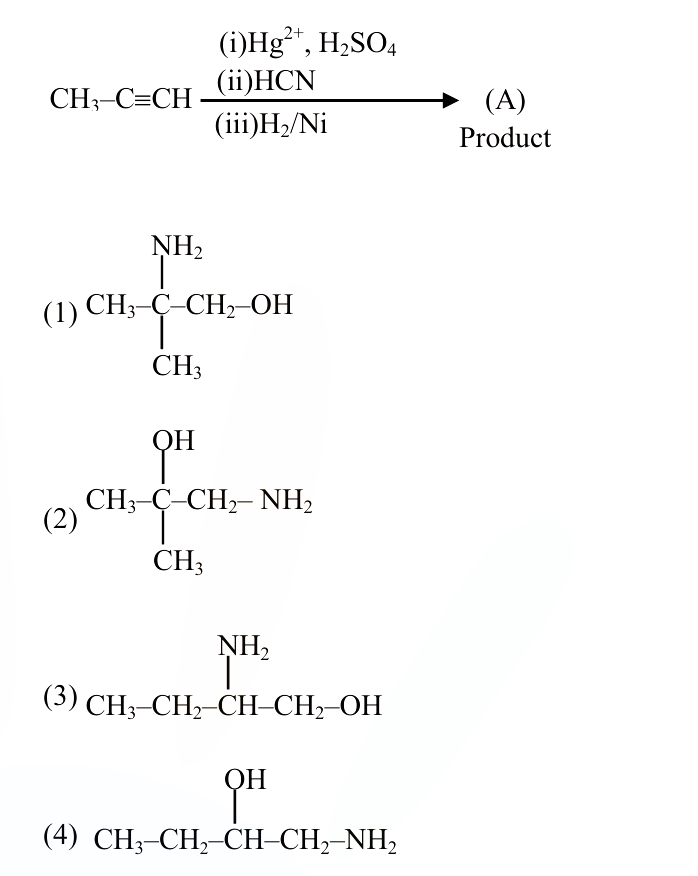
Reaction sequence showing propyne reacting with $$Hg^{2+}, H_2SO_4$$, then HCN, then $$H_2/Ni$$ to form product A, with four structural options shown below.
  • A

    CH3C(NH2)(CH3)CH2OH\text{CH}_3-\text{C}(\text{NH}_2)(\text{CH}_3)-\text{CH}_2-\text{OH}

  • B

    CH3C(OH)(CH3)CH2NH2\text{CH}_3-\text{C}(\text{OH})(\text{CH}_3)-\text{CH}_2-\text{NH}_2

  • C

    CH3CH2CH(NH2)CH2OH\text{CH}_3-\text{CH}_2-\text{CH}(\text{NH}_2)-\text{CH}_2-\text{OH}

  • D

    CH3CH2CH(OH)CH2NH2\text{CH}_3-\text{CH}_2-\text{CH}(\text{OH})-\text{CH}_2-\text{NH}_2

Answer

Correct answer:B

Step-by-step solution

Standard Method

Given: The starting compound is propyne CH3CCH\text{CH}_3-\text{C}\equiv\text{CH}. It is treated successively with Hg2+,H2SO4Hg^{2+}, H_2SO_4, then HCN, and finally H2/NiH_2/Ni.

Find: The structure of product (A).

From the given solution:

  1. Hydration of propyne in the presence of Hg2+,H2SO4Hg^{2+}, H_2SO_4 gives the ketone acetone.
CH3CCHCH3COCH3\text{CH}_3-\text{C}\equiv\text{CH} \longrightarrow \text{CH}_3-\text{CO}-\text{CH}_3
  1. Reaction of acetone with HCN forms the corresponding cyanohydrin.
CH3COCH3CH3C(OH)(CN)CH3\text{CH}_3-\text{CO}-\text{CH}_3 \longrightarrow \text{CH}_3-\text{C}(\text{OH})(\text{CN})-\text{CH}_3
  1. Hydrogenation with H2/NiH_2/Ni reduces the nitrile group (CN)(-\text{CN}) to (CH2NH2)(-\text{CH}_2\text{NH}_2).
CH3C(OH)(CN)CH3CH3C(OH)(CH2NH2)CH3\text{CH}_3-\text{C}(\text{OH})(\text{CN})-\text{CH}_3 \longrightarrow \text{CH}_3-\text{C}(\text{OH})(\text{CH}_2\text{NH}_2)-\text{CH}_3

Therefore, the final product is 2-amino-2-methylpropanol, corresponding to option B.

Stepwise reaction scheme showing propyne converted to acetone, then cyanohydrin formation, and finally reduction of nitrile to aminomethyl alcohol structure.

Reaction Sequence Mapping

Given: A three-step conversion of terminal alkyne is shown.

Find: Which option matches the final product.

The first reagent set Hg2+,H2SO4Hg^{2+}, H_2SO_4 carries out Markovnikov hydration of the terminal alkyne, giving a methyl ketone. Thus propyne forms acetone.

The carbonyl group of acetone then undergoes nucleophilic addition with HCN to give a cyanohydrin. In this product, the same carbon bears both OH and CN groups.

In the last step, catalytic hydrogenation with H2/NiH_2/Ni reduces the nitrile group to a primary amine side chain (CH2NH2)(-\text{CH}_2\text{NH}_2), while the OH group remains on the same carbon.

So the final arrangement is:

CH3C(OH)(CH3)CH2NH2\text{CH}_3-\text{C}(\text{OH})(\text{CH}_3)-\text{CH}_2\text{NH}_2

This matches option B.

Common mistakes

  • Confusing hydration of propyne with formation of an aldehyde. In the presence of Hg2+,H2SO4Hg^{2+}, H_2SO_4, a terminal alkyne gives a methyl ketone after enol-keto tautomerism. Start with acetone, not propanal.

  • Assuming HCN adds to form a chain-extended alcohol directly. It first forms a cyanohydrin, so both OH and CN become attached to the former carbonyl carbon.

  • Reducing the nitrile group incorrectly to NH2-\text{NH}_2 attached directly to the same carbon. On hydrogenation, CN-\text{CN} becomes CH2NH2-\text{CH}_2\text{NH}_2. Keep the extra methylene carbon in the product.

Practice more Aldehydes & Ketones questions

Get unlimited AI-adaptive practice, mastery tracking, and an AI tutor that explains every step — free to start.

Related questions