MCQMediumJEE 2025Alkenes (Electrophilic Addition, Polymerisation)

JEE Chemistry 2025 Question with Solution

Following are the four molecules P, Q, R and S. Which one among the four molecules will react with H-Br(aq) at the fastest rate?
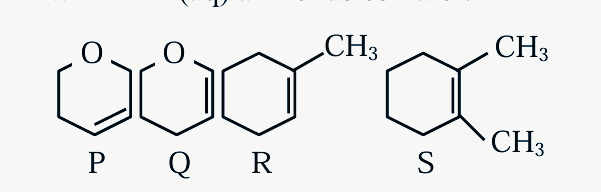
Four six-membered cyclic compounds labeled P, Q, R and S, showing oxygen atoms, double bonds, and CH3 substituents for comparison of reactivity with aqueous HBr.

Molecules: P:Cyclic compound with two O groups attached to the ring.P: \text{Cyclic compound with two O groups attached to the ring.} Q: \text{Cyclic compound with one O group and one CH_3 group attached to the ring.} R: \text{Cyclic compound with one O group attached to the ring and one CH_3 group attached to the ring.} S: \text{Cyclic compound with one CH_3 group attached to the ring.}

  • A

    S

  • B

    Q

  • C

    R

  • D

    P

Answer

Correct answer:B

Step-by-step solution

Standard Method

Given: Four molecules PP, QQ, RR and SS are compared for their rate of reaction with H-Br(aq).

Find: Which molecule reacts at the fastest rate.

The solution states that the speed of reaction with H-Br depends on how well the substituents stabilize the intermediate formed during reaction. Electron-donating groups increase reactivity by stabilizing the intermediate.

From the extracted working:

  1. Molecule P has two oxygen atoms attached to the ring. The solution notes that although resonance is possible, the overall effect is less favorable for the fastest reaction.
  2. Molecule Q has one oxygen atom and one CH3CH_3 group attached to the ring. The oxygen donates electron density by resonance, and the CH3CH_3 group provides inductive or hyperconjugative stabilization.
  3. Molecule R also has one oxygen atom and one CH3CH_3 group, but the arrangement is stated to be less favorable than QQ.
  4. Molecule S lacks oxygen support and is therefore less reactive than QQ.

The second extracted approach also concludes that QQ forms the most stable intermediate because it is resonance-stabilized.

Therefore, the molecule that reacts fastest with H-Br(aq) is Q. Hence, the correct option is B.

Detailed Comparison

Given: Reaction rate with H-Br(aq) is to be compared for four cyclic compounds.

Find: The most reactive molecule.

Hint used in the source: The reaction is faster when the intermediate formed is better stabilized by electron-donating groups.

  • In PP, the two oxygen atoms do not make it the fastest according to the provided solution.
  • In QQ, the oxygen atom can participate through resonance and the CH3CH_3 group helps stabilize the developing positive character.
  • In RR, a similar set of groups is present, but the source solution says the arrangement is less favorable than in QQ.
  • In SS, the ring has alkyl substitution but lacks oxygen participation, so it is less reactive than QQ.

Thus, based on the extracted solution text, QQ has the most favorable electronic stabilization and reacts at the fastest rate. The correct option is B.

Common mistakes

  • Assuming more heteroatoms always mean faster reaction. That is not always correct because the relative placement and the type of stabilization during the rate-determining step matter. Compare how each substituent stabilizes the intermediate, not just how many heteroatoms are present.

  • Focusing only on the CH3CH_3 group and ignoring resonance from oxygen. This is wrong because alkyl groups give weaker stabilization than a properly placed oxygen atom that can donate electron density by resonance. Consider both resonance and hyperconjugation together.

  • Treating QQ and RR as identical because both contain one oxygen and one CH3CH_3 group. This misses the effect of arrangement in the ring. Use the actual structure shown and compare which one gives the more favorable stabilized intermediate.

Practice more Alkenes (Electrophilic Addition, Polymerisation) questions

Get unlimited AI-adaptive practice, mastery tracking, and an AI tutor that explains every step — free to start.

Related questions