MCQEasyJEE 2025Aldehydes & Ketones

JEE Chemistry 2025 Question with Solution

Given below are two statements:

Statement (I): In the case of formaldehyde, KK is about 22802280, due to small substituents, hydration is faster.
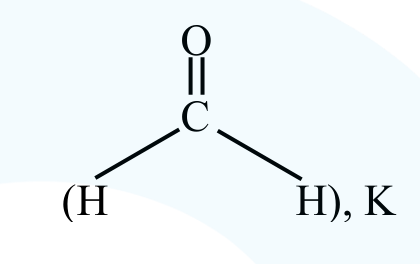
Structural formula of formaldehyde showing a carbonyl carbon double bonded to oxygen and single bonded to two hydrogens, with K mentioned alongside.

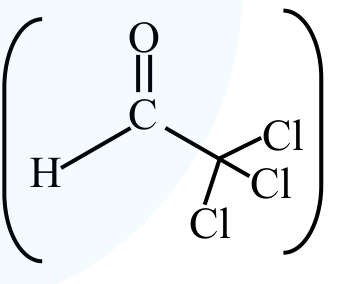
Statement (II): In the case of trichloroacetaldehyde, KK is about 20002000 due to the I-I effect of Cl.

Structural formula of trichloroacetaldehyde showing a carbonyl group attached to hydrogen and a carbon bearing three chlorine atoms, enclosed in brackets.

In the light of the above statements, choose the correct answer from the options given below:

  • A

    Statement I true but Statement II is false

  • B

    Both Statement I and Statement II are true

  • C

    Statement I is false but Statement II is true

  • D

    Both Statement I and Statement II are false

Answer

Correct answer:B

Step-by-step solution

Standard Method

Given: Two statements about hydration constants of formaldehyde and trichloroacetaldehyde.

Find: Which statement(s) are true.

Hydration of aldehydes depends on steric effects and electronic effects around the carbonyl group.

For Statement (I), formaldehyde has very small substituents around the carbonyl carbon. Therefore, steric hindrance is minimal and attack by water is easier. The given equilibrium constant K2280K \approx 2280 supports extensive hydration. Hence, Statement I is true.

For Statement (II), in trichloroacetaldehyde, the chlorine atoms show a strong I-I effect. This withdraws electron density and makes the carbonyl carbon more electrophilic, which favors hydration. The given value K2000K \approx 2000 is consistent with this. Hence, Statement II is true.

Therefore, both Statement I and Statement II are true. The correct option is B.

Detailed Analysis

Given:

  • Formaldehyde: K2280K \approx 2280
  • Trichloroacetaldehyde: K2000K \approx 2000

Find: Truth value of both statements.

The solution explains that the rate of hydration and the equilibrium constant depend on substituent effects on the carbonyl group. Small substituents favor nucleophilic attack because they reduce steric hindrance, while electron-withdrawing groups increase electrophilicity of the carbonyl carbon.

In formaldehyde, the carbonyl carbon is least hindered. Water can attack easily, so hydration is fast and strongly favored. Therefore the statement connecting small substituents with faster hydration is correct.

In trichloroacetaldehyde, the three chlorine atoms withdraw electron density through the inductive effect. This makes the carbonyl carbon more electron-deficient and more reactive toward hydration. Therefore the statement attributing the large KK value to the I-I effect of chlorine is also correct.

The second extracted solution text contains the phrase "making the carbonyl carbon less electrophilic," which contradicts the stated I-I effect explanation and the final marked answer. The primary solution and the declared correct option both support that both statements are true.

Hence, the correct option is B.

Common mistakes

  • Focusing only on steric hindrance and ignoring electronic effects. This is wrong because hydration depends on both accessibility and electrophilicity of the carbonyl carbon. Check both factors before judging the statement.

  • Assuming the I-I effect of chlorine decreases hydration. This is wrong because electron-withdrawing groups increase the positive character on the carbonyl carbon and generally favor nucleophilic addition. Use electrophilicity as the deciding idea.

  • Interpreting a large equilibrium constant KK only as a faster rate. This is incomplete because KK mainly describes the extent of hydration at equilibrium, not only the reaction speed. Separate kinetic and equilibrium ideas while reading the statement.

Practice more Aldehydes & Ketones questions

Get unlimited AI-adaptive practice, mastery tracking, and an AI tutor that explains every step — free to start.

Related questions