
Consider the following sequence of reactions to produce major product (A):
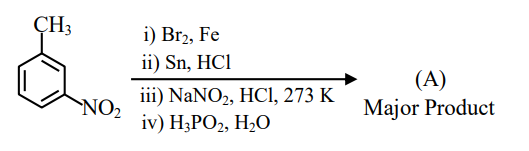
Molar mass of product (A) is _____ g mol. (Given molar mass in g mol of C: 12, H: 1, O: 16, Br: 80, N: 14, P: 31)
Consider the following sequence of reactions to produce major product (A):
Molar mass of product (A) is _____ g mol. (Given molar mass in g mol of C: 12, H: 1, O: 16, Br: 80, N: 14, P: 31)
Correct answer:171
Standard Method
Given: The starting material is 3-nitrotoluene and the reaction sequence is bromination, reduction, diazotization, and replacement of diazonium group by hydrogen.
Find: The molar mass of major product (A).
Step 1: On bromination with Br/Fe, substitution occurs at the position directed by the methyl group, giving major product 4-bromo-3-nitrotoluene.
Step 2: On treatment with Sn/HCl, the nitro group is reduced to an amino group, so the compound becomes 4-bromo-3-aminotoluene.
Step 3: With NaNO, HCl, 273 K, the amino group is converted into the diazonium salt.
Step 4: With HPO, HO, the diazonium group is replaced by hydrogen. Therefore, the final product is 4-bromotoluene with molecular formula CHBr.
Molar mass calculation:
Therefore, the molar mass of product (A) is .
Reaction-by-reaction structural analysis
Given: A substituted toluene undergoes four successive reactions.
Find: The molar mass of the major product.
Track the functional group changes through the sequence:
So the substituents finally present on the benzene ring are CH and Br, which gives 4-bromotoluene.
Hence, formula of (A) is CHBr.
Now calculate molar mass:
Thus, the required molar mass is 171.
Shortest identification trick
Given: The sequence converts -NO to -NH, then to diazonium salt, and finally replaces that group by H.
Find: The molar mass of the final product.
The shortcut is to notice that the last three steps together effectively remove the nitro-derived substituent from the ring and replace it by hydrogen. Therefore, after the first bromination step, only the introduced Br and the original CH remain in the final product.
So the final product is bromotoluene, specifically 4-bromotoluene, with formula CHBr.
Therefore, the answer is 171.
Assuming the nitro group remains in the final product is incorrect because Sn/HCl reduces it to -NH, and after diazotization followed by HPO, that substituent is replaced by H. Track the group through all steps before calculating molar mass.
Using the molecular mass of the diazonium salt intermediate is wrong because that species is not the final product. The required product is formed after treatment with HPO, HO, so calculate mass only for the final neutral aryl compound.
Placing bromine at the wrong position leads to an incorrect structure. In electrophilic substitution, both orientation effects and the stated major product matter. Use the directing effects to identify the major brominated intermediate before proceeding.
Get unlimited AI-adaptive practice, mastery tracking, and an AI tutor that explains every step — free to start.