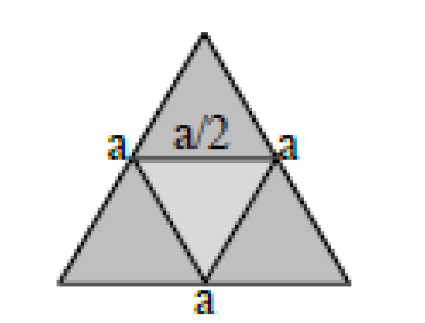
Let ABC be an equilateral triangle. A new triangle is formed by joining the midpoints of all sides of the triangle ABC, and the same process is repeated infinitely many times. If P is the sum of the perimeters and Q is the sum of areas of all the triangles formed in this process, then:
A
P2=363Q
B
P2=63Q
C
P=363Q2
D
P2=723Q
Answer
Correct answer:A
Step-by-step solution
Standard Method
Given: An equilateral triangle of side a is repeatedly replaced by the triangle formed by joining the midpoints of its sides.
Find: The relation between P and Q.
The side lengths of successive triangles are:
a,2a,4a,…
So their perimeters form a geometric series:
P=3a+3⋅2a+3⋅4a+⋯=3a(1+21+41+⋯)
Using the sum of the infinite geometric series,
P=3a⋅1−211=6a
The area of an equilateral triangle of side a is:
43a2
Hence the areas of successive triangles are:
43a2,163a2,643a2,…
Therefore,
Q=43a2(1+41+161+⋯)
Again using the sum of the infinite geometric series,
Q=43a2⋅1−411=33a2
Now from
P=6a
we get
a=6P
Substituting into Q,
Q=33(6P)2=1083P2
So,
P2=363Q
Therefore, the correct option is A.
Geometric Series Approach
Given: Each new triangle is obtained by joining the midpoints of the sides of the previous equilateral triangle.
Find: A direct relation between P2 and Q.
By the midpoint theorem, each new triangle has side half of the previous one. Therefore the perimeters are in the ratio 1:21:41:… and the areas are in the ratio 1:41:161:….
Perimeter sum:
P=3a(1+21+41+⋯)=3a⋅2=6a
Hence,
P2=36a2
Area sum:
Q=43a2(1+41+161+⋯)
Since
1+41+161+⋯=1−411=34
we get
Q=43a2⋅34=33a2
Therefore,
QP2=33a236a2=363
Hence,
P2=363Q
This matches option A. Note: the line in the source solution stating "Answer: (1)P=363Q" is a typo; the derived result and the option list both confirm P2=363Q.
Common mistakes
Students often assume the area also scales by 21 because the side scales by 21. This is wrong because area depends on the square of the side. Use area ratio (21)2=41 instead.
A common mistake is to omit the original triangle from the sums P and Q. The process includes the first triangle as the first term of both geometric series, so begin with 3a for perimeter and 43a2 for area.
Some students use the wrong infinite series formula or interchange the common ratios for perimeter and area. The perimeter series has ratio 21, while the area series has ratio 41. Keep these two series separate before relating P and Q.
Practice more Sum of Series questions
Get unlimited AI-adaptive practice, mastery tracking, and an AI tutor that explains every step — free to start.