
Which of the following compounds can give a positive iodoform test when treated with aqueous KOH solution followed by potassium hypoiodite?
- A
Option 1
- B
Option 2
- C
Option 3
- D
Option 4
Which of the following compounds can give a positive iodoform test when treated with aqueous KOH solution followed by potassium hypoiodite?
Option 1
Option 2
Option 3
Option 4
Correct answer:B
Standard Method
Given: A compound giving a positive iodoform test must contain a methyl ketone group or an alcohol that can be oxidized to it.
Find: Which option gives a positive iodoform test.
The solution states that the iodoform test identifies methyl ketones or compounds oxidizable to methyl ketones.
It further concludes:
Therefore, only Compound 2 gives a positive iodoform test. The correct option is B.
Reaction-Based Explanation
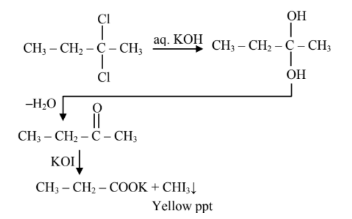
Given: The reaction scheme in the solution shows formation of a ketone that responds to the iodoform test.
Find: Which option matches the compound giving positive iodoform test.
From the figure, aqueous KOH converts the precursor into a carbonyl compound, and subsequent treatment with gives as yellow precipitate.
The ketone formed is of the methyl ketone type, so it gives a positive iodoform test.
Hence, the correct option is B.
Assuming every ketone gives the iodoform test is incorrect. Only methyl ketones with the group , or compounds oxidizable to them, respond positively.
Ignoring oxidizable alcohols is a mistake. Some alcohols also give the test because they are first oxidized to methyl ketones under the reaction conditions.
Relying only on the answer key text can be misleading here because it conflicts with the worked solution. The solution clearly concludes that only Compound 2 is correct.
Get unlimited AI-adaptive practice, mastery tracking, and an AI tutor that explains every step — free to start.