
MCQMediumJEE 2023Isomerism (Structural, Stereoisomerism)

JEE Chemistry 2023 Question with Solution

Provided that below are two statements, one is labelled as Assertion AA and the other is labelled as Reason RR.

Assertion AA : A solution of the product obtained by heating a mole of glycine with a mole of chlorine in presence of red phosphorous generates chiral carbon atom.

Reason RR : A molecule with 22 chiral carbons is always optically active.

In the light of the above statements, choose the correct answer from the options Provided that below:

  • A

    A is false but R is true

  • B

    Both A and R are true but R is NOT the correct explanation of A

  • C

    A is true but R is false

  • D

    Both A and R are true and R is the correct explanation of A
Answer

Correct answer:C

Step-by-step solution

Standard Method

Given: Assertion about chlorination of glycine in presence of red phosphorus, and a Reason about molecules with 22 chiral carbons.

Find: Which option correctly evaluates Assertion AA and Reason RR.

For Assertion AA, glycine is NH2CH2COOH\text{NH}_2\text{CH}_2\text{COOH}. In the presence of chlorine and red phosphorus, α\alpha-halogenation occurs to give:

NH2CH2COOH+Cl2Red PNH2CHClCOOH\text{NH}_2\text{CH}_2\text{COOH} + \text{Cl}_2 \xrightarrow{\text{Red P}} \text{NH}_2\text{CHClCOOH}

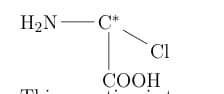
In the product, the carbon attached to NH2\text{NH}_2, Cl\text{Cl}, H\text{H} and COOH\text{COOH} has four different groups, so it is a chiral carbon atom. Therefore, Assertion AA is true.

Structure showing the central carbon marked with an asterisk bonded to H2N, Cl, H, and COOH, indicating a chiral center.

For Reason RR, the statement 'a molecule with 22 chiral carbons is always optically active' is false. A compound with two chiral centers can be optically inactive if it contains an internal plane of symmetry. Such compounds are called meso compounds.

Therefore, Reason RR is false.

Hence, Assertion AA is true but Reason RR is false. The correct option is C.

Why the chiral center is formed

Given: Glycine undergoes chlorination in presence of red phosphorus.

Find: Whether the product contains a chiral carbon.

The starting amino acid is glycine, NH2CH2COOH\text{NH}_2\text{CH}_2\text{COOH}. After substitution at the α\alpha-carbon, the product becomes NH2CHClCOOH\text{NH}_2\text{CHClCOOH}. Now inspect the substituted carbon:

  • it is attached to NH2\text{NH}_2
  • it is attached to Cl\text{Cl}
  • it is attached to H\text{H}
  • it is attached to COOH\text{COOH}

Since all four attached groups are different, that carbon is chiral. This confirms the Assertion.

Common mistakes

  • Assuming glycine itself is chiral. This is wrong because in glycine the α\alpha-carbon is attached to two hydrogens, so it is achiral. Check the groups attached after halogenation.

  • Believing that any molecule with 22 chiral carbons must be optically active. This is wrong because meso compounds have chiral centers but are optically inactive due to internal symmetry. Always test for a plane of symmetry.

  • Confusing the reaction product and concluding that chlorination does not create asymmetry. The substitution of one hydrogen on the α\alpha-carbon by chlorine changes the attached groups to four different groups, which creates chirality.

Practice more Isomerism (Structural, Stereoisomerism) questions

Get unlimited AI-adaptive practice, mastery tracking, and an AI tutor that explains every step — free to start.

Related questions