
MCQMediumJEE 2023Alkyl Halides

JEE Chemistry 2023 Question with Solution

Product [X] formed in the above reaction is:
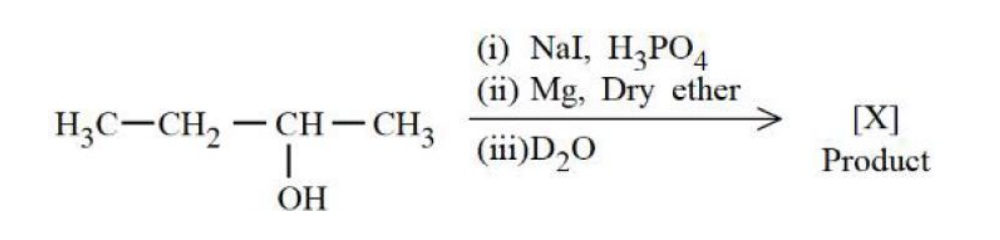
Reaction scheme showing butan-2-ol treated successively with NaI and H3PO4, then Mg in dry ether, then D2O to form product X.
  • A

    CH3CH2CH(D)CH3CH_3-CH_2-CH(D)-CH_3

  • B

    CH3CH2CH=CH2CH_3-CH_2-CH=CH_2

  • C

    CH3CH=CHCH3CH_3-CH=CH-CH_3

  • D

    CH3CH2C(OH)(H)CH3CH_3-CH_2-C(OH)(H)-CH_3

Answer

Correct answer:A

Step-by-step solution

Standard Method

Given: The substrate is butan-2-ol, which is treated with NaI, H3PO4\text{NaI, H}_3\text{PO}_4, then Mg\text{Mg} in dry ether, and finally D2O\text{D}_2\text{O}.

Find: The product [X] formed after the reaction sequence.

First, the alcohol is converted into the corresponding iodoalkane:

CH3CH2CH(OH)CH3NaI, H3PO4CH3CH2CH(I)CH3\text{CH}_3-\text{CH}_2-\text{CH(OH)}-\text{CH}_3 \xrightarrow{\text{NaI, H}_3\text{PO}_4} \text{CH}_3-\text{CH}_2-\text{CH(I)}-\text{CH}_3

Next, the iodoalkane reacts with magnesium in dry ether to form the Grignard reagent:

CH3CH2CH(I)CH3Mg, Dry EtherCH3CH2CH(MgI)CH3\text{CH}_3-\text{CH}_2-\text{CH(I)}-\text{CH}_3 \xrightarrow{\text{Mg, Dry Ether}} \text{CH}_3-\text{CH}_2-\text{CH(MgI)}-\text{CH}_3

Finally, hydrolysis with deuterated water replaces the C-MgI\text{C-MgI} bond by a C-D\text{C-D} bond:

CH3CH2CH(MgI)CH3D2OCH3CH2CH(D)CH3\text{CH}_3-\text{CH}_2-\text{CH(MgI)}-\text{CH}_3 \xrightarrow{\text{D}_2\text{O}} \text{CH}_3-\text{CH}_2-\text{CH(D)}-\text{CH}_3

Therefore, the product formed is CH3CH2CH(D)CH3\text{CH}_3-\text{CH}_2-\text{CH(D)}-\text{CH}_3. The correct option is A.

The solution labels the correct option as D, but its worked steps and final product clearly match option A.

Reaction Sequence Logic

Given: A secondary alcohol undergoes three consecutive transformations.

Find: Which listed structure corresponds to the final product.

The role of each reagent is:

  1. NaI/H3PO4\text{NaI/H}_3\text{PO}_4 converts the alcohol into the alkyl iodide.
  2. Mg\text{Mg} in dry ether inserts into the C-I\text{C-I} bond to form a Grignard reagent.
  3. D2O\text{D}_2\text{O} quenches the Grignard reagent and introduces deuterium at the carbon attached to magnesium.

So the carbon that originally bore OH\text{OH} finally bears D\text{D}:

R-OHR-IR-MgIR-D\text{R-OH} \rightarrow \text{R-I} \rightarrow \text{R-MgI} \rightarrow \text{R-D}

Hence, the final structure must be CH3CH2CH(D)CH3\text{CH}_3-\text{CH}_2-\text{CH(D)}-\text{CH}_3, not an alkene or an alcohol. Therefore, the correct option is A.

Common mistakes

  • Assuming D2O\text{D}_2\text{O} behaves like an elimination reagent is incorrect. It only quenches the Grignard reagent and replaces C-MgI\text{C-MgI} with C-D\text{C-D}. Track the organomagnesium intermediate before deciding the product.

  • Stopping after formation of the alkyl iodide is wrong because the reaction sequence continues with Mg\text{Mg} and then D2O\text{D}_2\text{O}. Always follow all listed reagents in order.

  • Choosing an alcohol-containing product is incorrect because the original OH\text{OH} group is first replaced by iodine. After Grignard formation and deuterolysis, the final product contains D\text{D}, not OH\text{OH}.

Practice more Alkyl Halides questions

Get unlimited AI-adaptive practice, mastery tracking, and an AI tutor that explains every step — free to start.

Related questions