
Arrange the following compounds in increasing order of rate of aromatic electrophilic substitution reaction:
- A
(a) < (b) < (c)
- B
(b) < (c) < (a)
- C
(c) < (a) < (b)
- D
(c) < (b) < (a)
Arrange the following compounds in increasing order of rate of aromatic electrophilic substitution reaction:
(a) < (b) < (c)
(b) < (c) < (a)
(c) < (a) < (b)
(c) < (b) < (a)
Correct answer:A
Standard Method
Given: The compounds differ by substituents that either donate or withdraw electron density from the aromatic ring during electrophilic aromatic substitution.
Find: The increasing order of rate of aromatic electrophilic substitution reaction.
Groups like and activate the aromatic ring by donating electron density, whereas and deactivate it by withdrawing electron density.
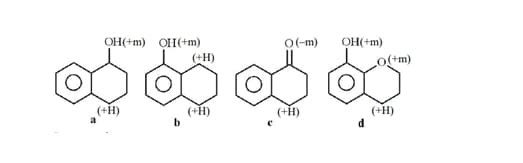
Benzene becomes more reactive towards electrophilic aromatic substitution when an electron-donating group is attached to the benzene ring. Benzene with electron-withdrawing groups decreases the reactivity, as it deactivates the ring towards electrophilic attack.
Thus, the order is:
Therefore, the correct option is A.
Assuming all oxygen-containing groups activate the ring. This is wrong because groups such as carbonyl-containing substituents withdraw electron density, whereas donates by resonance. Check the actual electronic effect before ranking reactivity.
Ignoring resonance donation and considering only inductive effect. This gives an incorrect order because electrophilic aromatic substitution rate is strongly influenced by resonance interaction with the ring. Use activating versus deactivating behavior to compare the compounds.
Get unlimited AI-adaptive practice, mastery tracking, and an AI tutor that explains every step — free to start.