
MCQEasyJEE 2023Phenols

JEE Chemistry 2023 Question with Solution

The correct order for acidity of the following hydroxyl compounds is:
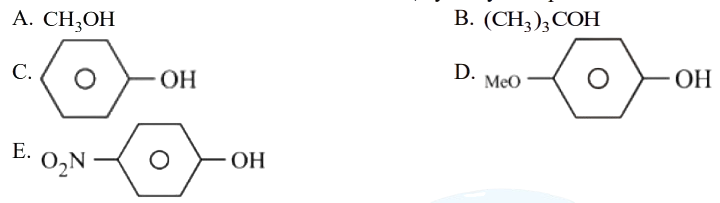
Five hydroxyl compounds labeled A, B, C, D and E including methanol, tert-butanol, phenol, methoxy substituted phenol and nitro substituted phenol for acidity comparison.

Choose the correct answer from the options given below:

  • A

    E >> C >> D >> A >> B

  • B

    D >> E >> C >> A >> B

  • C

    E >> D >> C >> B >> A

  • D

    C >> E >> D >> B >> A

Answer

Correct answer:A

Step-by-step solution

Standard Method

Given: The acidity order of hydroxyl compounds A, B, C, D and E is to be compared.

Find: The correct decreasing order of acidity.

Acidity of a compound is related to the stability of its conjugate base. The more stabilized the conjugate base, the stronger the acid.

  • E (NO2-group)(\text{NO}_2\text{-group}): The NO2\text{NO}_2 group is electron-withdrawing and stabilizes the conjugate base, increasing the acidity.
  • C (Phenol): This has no electron-donating or electron-withdrawing group, so it has moderate acidity.
  • D (Methoxy group, OCH3\text{OCH}_3): The methoxy group is electron-donating and reduces the acidity by destabilizing the conjugate base.
  • A (Methanol): Alcohols generally have low acidity compared to phenols due to the absence of a conjugate base that can be stabilized by resonance.
  • B (Tertiary alcohol): The tertiary alcohol, due to steric hindrance and electron-donating alkyl groups, is the least acidic.

Thus, the correct order of acidity is

E>C>D>A>B\text{E} > \text{C} > \text{D} > \text{A} > \text{B}

Therefore, the correct option is A. The solution shows D, but the worked conclusion matches option A.

Conjugate Base Stability Logic

Given: Substituted phenols and alcohols are to be arranged in order of acidity.

Find: Which option matches the correct order.

The key idea is conjugate base stabilization:

  1. Phenoxide ions are more stable than simple alkoxide ions because the negative charge can be delocalized by resonance.
  2. An electron-withdrawing group further stabilizes the phenoxide ion and increases acidity.
  3. An electron-donating group destabilizes the phenoxide ion and decreases acidity.
  4. Among ordinary alcohols, tertiary alcohol is less acidic than methanol because alkyl groups donate electron density and reduce stability of the conjugate base.

So,

nitro substituted phenol>phenol>methoxy substituted phenol>methanol>tert-butanol\text{nitro substituted phenol} > \text{phenol} > \text{methoxy substituted phenol} > \text{methanol} > \text{tert-butanol}

which corresponds to

E>C>D>A>B\text{E} > \text{C} > \text{D} > \text{A} > \text{B}

Hence, the correct option is A.

Common mistakes

  • Comparing only the presence of OH\text{OH} and ignoring conjugate base stability is incorrect. Acidity depends on how stable the species formed after loss of H+\text{H}^+ is. Always compare the conjugate bases first.

  • Assuming all alcohols are more acidic than phenols because alcohols are simpler is wrong. Phenol is more acidic because the phenoxide ion is resonance stabilized, whereas alkoxide ions are not.

  • Treating the OCH3\text{OCH}_3 group as acidity increasing in phenol is a mistake. Here it behaves as an electron-donating group overall and destabilizes the conjugate base relative to phenol. Check whether a substituent withdraws or donates electron density.

Practice more Phenols questions

Get unlimited AI-adaptive practice, mastery tracking, and an AI tutor that explains every step — free to start.

Related questions