
A particle of mass moving with velocity collides with a stationary particle of mass . After collision, they stick together and continue to move together with velocity:
- A
- B
- C
- D
A particle of mass moving with velocity collides with a stationary particle of mass . After collision, they stick together and continue to move together with velocity:
Correct answer:B
Conservation of Momentum
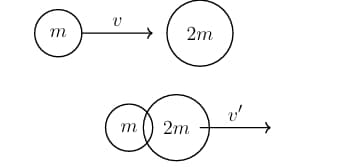
Given: First particle has mass and velocity . Second particle has mass and is at rest.
Find: The common velocity after collision when both particles stick together.
Since the particles stick together, this is a perfectly inelastic collision. Use conservation of linear momentum.
Initial momentum:
Combined mass after collision:
Let the final common velocity be . Then final momentum is:
By conservation of momentum:
So,
Hence,
Therefore, the final velocity is . The correct option is B.
The solution labels the option as C, but the working clearly gives , which matches option B in the provided options.
Using conservation of kinetic energy instead of conservation of momentum is incorrect because the particles stick together, so the collision is inelastic. Use only linear momentum conservation to find the final velocity.
Adding masses incorrectly after collision is wrong. Since the particles move together, the combined mass becomes , not or .
Forgetting that the second particle is initially at rest leads to an extra momentum term. Its initial velocity is , so its initial momentum contribution is .
Get unlimited AI-adaptive practice, mastery tracking, and an AI tutor that explains every step — free to start.