
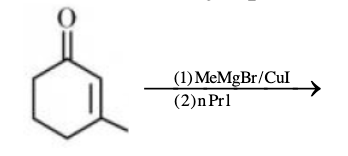
Find out the major product from the following reaction.
- A
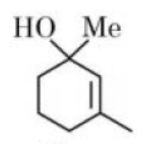
- B
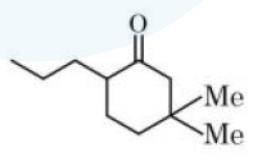
- C
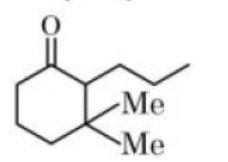
- D
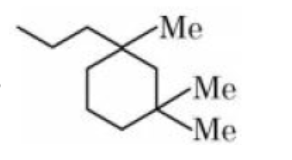
Find out the major product from the following reaction.
Correct answer:C
Standard Method
Given: The substrate is an -unsaturated ketone treated with MeMgBr/CuI followed by n-PrI.
Find: The major product formed in the reaction.
The reaction proceeds in two steps:
1,4-addition of the organocuprate: The organocuprate reagent (MeMgBr/CuI) adds to the -unsaturated ketone in a -conjugate addition manner. This results in the formation of a ketone with a methyl group at the position.
Alkylation of the ketone: The resulting ketone reacts with n-propyl iodide in an alkylation reaction. The enolate of the ketone attacks the alkyl halide, adding the n-propyl group to the -carbon.
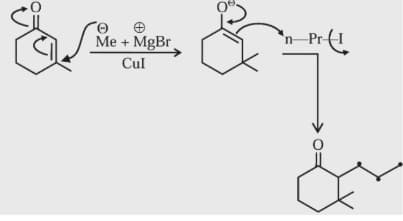
Therefore, the major product is option (3). Hence, the correct option is C.
Choosing -addition instead of -addition is incorrect because organocuprate-type reagents formed with CuI preferentially undergo conjugate addition to -unsaturated carbonyl compounds. Use -addition first.
Placing the n-propyl group at the wrong carbon is incorrect because alkylation occurs through the enolate, which reacts at the -carbon. After conjugate addition, identify the enolate position before adding the alkyl halide.
Ignoring retention of the ketone functionality is incorrect because conjugate addition followed by alkylation does not reduce the carbonyl group. Keep the C=O group present in the final product.
Get unlimited AI-adaptive practice, mastery tracking, and an AI tutor that explains every step — free to start.