MCQEasyJEE 2023Rate of Reaction

JEE Chemistry 2023 Question with Solution

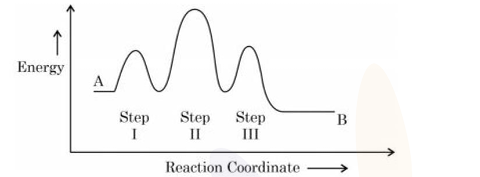
Consider the following reaction that goes from AA to BB in three steps as shown below:

Reaction energy diagram from A to B with three peaks labeled Step I, Step II, and Step III, showing two valleys between peaks and energy versus reaction coordinate axes.Table of four options comparing number of intermediates, number of activated complexes, and the rate determining step labeled I, II, or III.
  • A

    22

    33

    II

  • B

    33

    22

    II

  • C

    22

    33

    III

  • D

    22

    33

    I

Answer

Correct answer:A

Step-by-step solution

Standard Method

Given: The reaction coordinate diagram from AA to BB has three peaks corresponding to Step I, Step II, and Step III.

Find: The number of intermediates, the number of activated complexes, and the rate-determining step.

In a reaction energy profile, intermediates are the species formed during the reaction and then consumed in later steps. They appear as the valleys between two successive peaks.

Here, the diagram shows two valleys, so the number of intermediates is 22.

Activated complexes correspond to the transition states of each elementary step and appear at the peaks of the energy diagram.

Since the diagram has three peaks, the number of activated complexes is 33.

The rate-determining step is the step with the highest activation energy barrier. Among the three peaks, the peak for Step II is the highest.

Therefore, Step II is the rate-determining step.

Therefore, the correct option is A: 22 intermediates, 33 activated complexes, and Step II as the rate-determining step.

Energy Diagram Analysis

Given: A three-step reaction energy diagram is provided.

Find: Count the valleys and peaks, then identify the highest barrier.

For a multistep reaction:

  • each valley between peaks represents an intermediate
  • each peak represents an activated complex or transition state

From the diagram:

  • Number of valleys = 22
  • Number of peaks = 33

Now compare the heights of the three peaks. The peak corresponding to Step II is the highest, so Step II has the largest activation energy.

Hence, the slowest step is Step II, which is the rate-determining step.

So the correct combination is 22 intermediates, 33 activated complexes, and II as the rate-determining step. The correct option is A.

Common mistakes

  • Counting AA and BB as intermediates is incorrect because they are reactant and product, not species formed and consumed during the mechanism. Count only the valleys between peaks as intermediates.

  • Counting steps instead of peaks for activated complexes can cause confusion. Activated complexes correspond to the top of each energy barrier, so identify the peaks directly.

  • Choosing the step with the deepest valley as the rate-determining step is wrong. The rate-determining step depends on the highest activation energy barrier, not on the stability of an intermediate.

Practice more Rate of Reaction questions

Get unlimited AI-adaptive practice, mastery tracking, and an AI tutor that explains every step — free to start.

Related questions