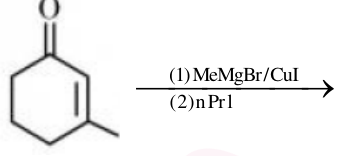
Find out the major product from the following reaction:
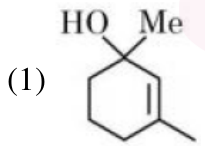
- A
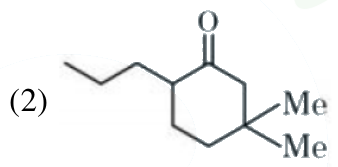
- B
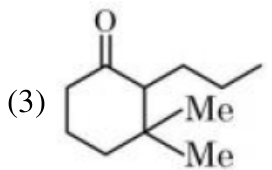
- C
- D
Find out the major product from the following reaction:


Correct answer:C
Standard Method
Given: The substrate is an -unsaturated ketone treated with and then .
Find: The major product formed in the reaction.
The given reaction involves two steps.
Reaction with : In the presence of , the Grignard reagent behaves as a softer nucleophile and gives -conjugate addition to the enone system rather than direct -addition to the carbonyl group.
This places a methyl group at the -carbon and generates an enolate intermediate.
Reaction with : The enolate is then alkylated at the -carbon by .
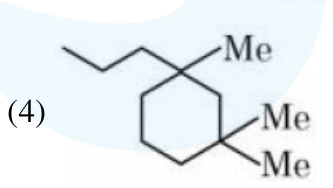
So, the final product is the cyclohexanone retaining the carbonyl group, with propyl substitution at the -position and gem-dimethyl substitution at the -position.
Therefore, the correct option is C.
Why conjugate addition dominates
Given: An enone reacts with followed by .
Find: Why the product corresponds to option C.
For an -unsaturated ketone, a normal Grignard reagent often favors -addition. However, in the presence of , an organocuprate-like species is formed, and such reagents preferentially undergo -addition.
After -addition of , the double bond is saturated and an enolate is formed:
This enolate then reacts with by -alkylation, giving the ketone with a new propyl group next to the carbonyl.
Hence, the product must:
Among the given structures, this matches option C.
Assuming gives direct -addition to the carbonyl is incorrect here because changes the reactivity to favor -conjugate addition. Check the presence of copper salts before choosing the addition pattern.
Forgetting that the intermediate after conjugate addition is an enolate leads to the wrong second-step product. The enolate is trapped by through -alkylation, so the propyl group appears next to the carbonyl.
Choosing an alcohol product is a common error because students confuse this with ordinary Grignard addition to ketones. In this reaction, the carbonyl is retained after conjugate addition and alkylation, so the final product is still a ketone.
Get unlimited AI-adaptive practice, mastery tracking, and an AI tutor that explains every step — free to start.