
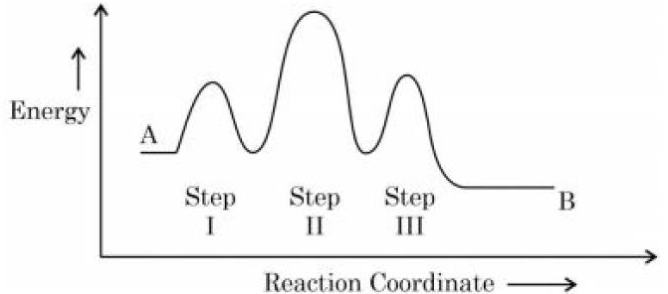
Consider the following reaction that goes from to in three steps as shown below:
Choose the correct option:
Number of Intermediates | Number of Activated complexes | Rate determining step
- A
| | II
- B
| | II
- C
| | III
- D
| | I
Consider the following reaction that goes from to in three steps as shown below:
Choose the correct option:
Number of Intermediates | Number of Activated complexes | Rate determining step
| | II
| | II
| | III
| | I
Correct answer:A
Standard Method
Given: A reaction energy diagram shows conversion from to in three steps: I, II, and III.
Find: The number of intermediates, the number of activated complexes, and the rate-determining step.
Intermediates are species formed during a reaction that are subsequently consumed. In an energy profile, they are represented by the valleys between successive peaks. In the given diagram, there are two valleys, so there are intermediates.
Activated complexes are the transition states present at the top of each energy barrier. In the given diagram, there are three peaks, so there are activated complexes.
The rate-determining step is the slowest step, which corresponds to the step having the highest activation energy barrier. In the given diagram, Step II has the highest peak, so Step II is the rate-determining step.
Therefore, the correct option is A.
Energy Diagram Interpretation
Given: The reaction proceeds in three steps and its energy profile contains three maxima and two minima between reactant and product .
Find: Which option correctly matches the intermediates, activated complexes, and rate-determining step.
In a multi-step energy diagram:
Applying this to the diagram:
Hence, the correct combination is | | II, so the correct option is A.
Counting and as intermediates is incorrect because they are the reactant and product, not species formed and consumed during the mechanism. Count only the valleys between peaks as intermediates.
Counting steps instead of peaks for activated complexes is incorrect. Activated complexes correspond to the tops of the energy barriers, so you must count the peaks in the energy profile.
Choosing the first or last step as the rate-determining step without comparing barrier heights is incorrect. The correct method is to identify the step with the highest activation energy, which is the tallest peak.
Get unlimited AI-adaptive practice, mastery tracking, and an AI tutor that explains every step — free to start.