
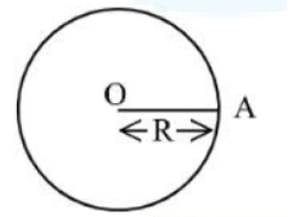
For a uniformly charged thin spherical shell, the electric potential () radially away from the center of the shell can be graphically represented as:
- A
- B
- C
- D
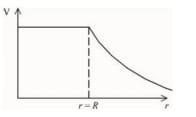
For a uniformly charged thin spherical shell, the electric potential () radially away from the center of the shell can be graphically represented as:
Correct answer:D
Standard Method
Given: A uniformly charged thin spherical shell.
Find: The graph of electric potential as a function of radial distance from the center.
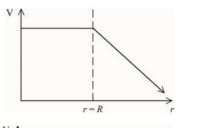
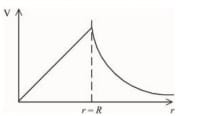
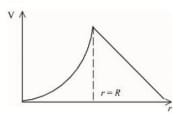
For a thin spherical shell, the electric potential is constant everywhere inside the shell:
for .
Outside the shell, the potential is the same as that due to a point charge placed at the center:
for .
So, from the center up to , the graph is a horizontal line. Beyond , the potential decreases with following an inverse relation.
Therefore, the correct option is D.
Assuming the potential inside the shell is zero because the electric field inside is zero. This is incorrect because zero electric field means the potential is constant, not necessarily zero. Use for all .
Confusing the shell with a solid uniformly charged sphere. For a solid sphere, the potential inside varies with , but for a thin spherical shell it remains constant inside. Identify the charge distribution before choosing the graph.
Get unlimited AI-adaptive practice, mastery tracking, and an AI tutor that explains every step — free to start.