MCQMediumJEE 2023Sum of Series

JEE Mathematics 2023 Question with Solution

The sum of the first 2020 terms of the series 5+11+19+29+41+5 + 11 + 19 + 29 + 41 + \cdots is:

  • A

    34503450

  • B

    34203420

  • C

    35203520

  • D

    32503250

Answer

Correct answer:C

Step-by-step solution

Standard Method

Given: The series is 5+11+19+29+41+5 + 11 + 19 + 29 + 41 + \cdots.

Find: The sum of the first 2020 terms, that is S20S_{20}.

Assume the nthn^{\text{th}} term is of the form

Tn=an2+bn+cT_n = an^2 + bn + c
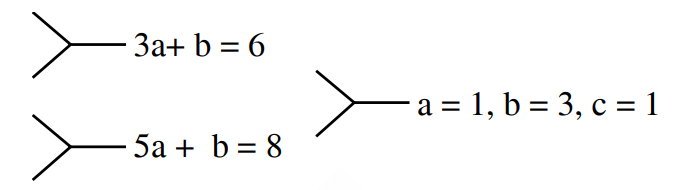
Zigzag difference diagram for the series 5, 11, 19, 29, 41 showing first differences 6, 8, 10, 12 and noting that the first differences form an arithmetic progression.Coefficient comparison diagram showing equations 3a plus b equals 6 and 5a plus b equals 8, leading to values a equals 1, b equals 3, and c equals 1.

Using the given terms:

T1=a+b+c=5T_1 = a + b + c = 5 T2=4a+2b+c=11T_2 = 4a + 2b + c = 11 T3=9a+3b+c=19T_3 = 9a + 3b + c = 19

Hence,

Tn=n2+3n+1T_n = n^2 + 3n + 1

Now,

S20=n=120Tn=n=120(n2+3n+1)S_{20} = \sum_{n=1}^{20} T_n = \sum_{n=1}^{20}(n^2 + 3n + 1)

So,

S20=20×21×416+3×20×212+20S_{20} = \frac{20 \times 21 \times 41}{6} + 3 \times \frac{20 \times 21}{2} + 20 S20=2870+630+20S_{20} = 2870 + 630 + 20 S20=3520S_{20} = 3520

Therefore, the sum of the first 2020 terms is 35203520. The correct option is C.

Using first differences

Given: The series is 5+11+19+29+41++Tn5 + 11 + 19 + 29 + 41 + \cdots + T_n.

Find: S20S_{20}.

Find consecutive differences:

115=611 - 5 = 6 1911=819 - 11 = 8 2919=1029 - 19 = 10 4129=1241 - 29 = 12

These differences form an arithmetic progression with first term 66 and common difference 22.

The nthn^{\text{th}} term of this difference AP is

an=6+(n1)2=2n+4a_n = 6 + (n - 1)2 = 2n + 4

Hence the nthn^{\text{th}} term of the original series is

Tn=5+k=1n1(2k+4)T_n = 5 + \sum_{k=1}^{n-1}(2k + 4) Tn=5+2k=1n1k+4(n1)T_n = 5 + 2\sum_{k=1}^{n-1} k + 4(n - 1) Tn=5+2(n1)n2+4(n1)T_n = 5 + 2 \cdot \frac{(n - 1)n}{2} + 4(n - 1) Tn=5+n2n+4n4=n2+3n+1T_n = 5 + n^2 - n + 4n - 4 = n^2 + 3n + 1

Therefore,

S20=n=120(n2+3n+1)S_{20} = \sum_{n=1}^{20}(n^2 + 3n + 1) S20=n=120n2+3n=120n+n=1201S_{20} = \sum_{n=1}^{20} n^2 + 3\sum_{n=1}^{20} n + \sum_{n=1}^{20} 1

Using

n=1Nn=N(N+1)2\sum_{n=1}^{N} n = \frac{N(N+1)}{2}

and

n=1Nn2=N(N+1)(2N+1)6\sum_{n=1}^{N} n^2 = \frac{N(N+1)(2N+1)}{6}

we get

S20=20(21)(41)6+320(21)2+20S_{20} = \frac{20(21)(41)}{6} + 3\frac{20(21)}{2} + 20 S20=2870+630+20=3520S_{20} = 2870 + 630 + 20 = 3520

Thus, the sum of the first 2020 terms is 35203520.

Common mistakes

  • Assuming the given series itself is an arithmetic progression is incorrect because the consecutive differences are 6,8,10,126, 8, 10, 12, not constant. First check the pattern of differences before applying AP formulas.

  • Using the wrong expression for TnT_n is a common error. Since the first differences are in AP, the original sequence is quadratic in nn, so take Tn=an2+bn+cT_n = an^2 + bn + c or build it from the difference pattern.

  • While summing n=120(n2+3n+1)\sum_{n=1}^{20}(n^2 + 3n + 1), students often forget that 1=20\sum 1 = 20. The constant term must also be added for all 2020 terms.

Practice more Sum of Series questions

Get unlimited AI-adaptive practice, mastery tracking, and an AI tutor that explains every step — free to start.

Related questions