
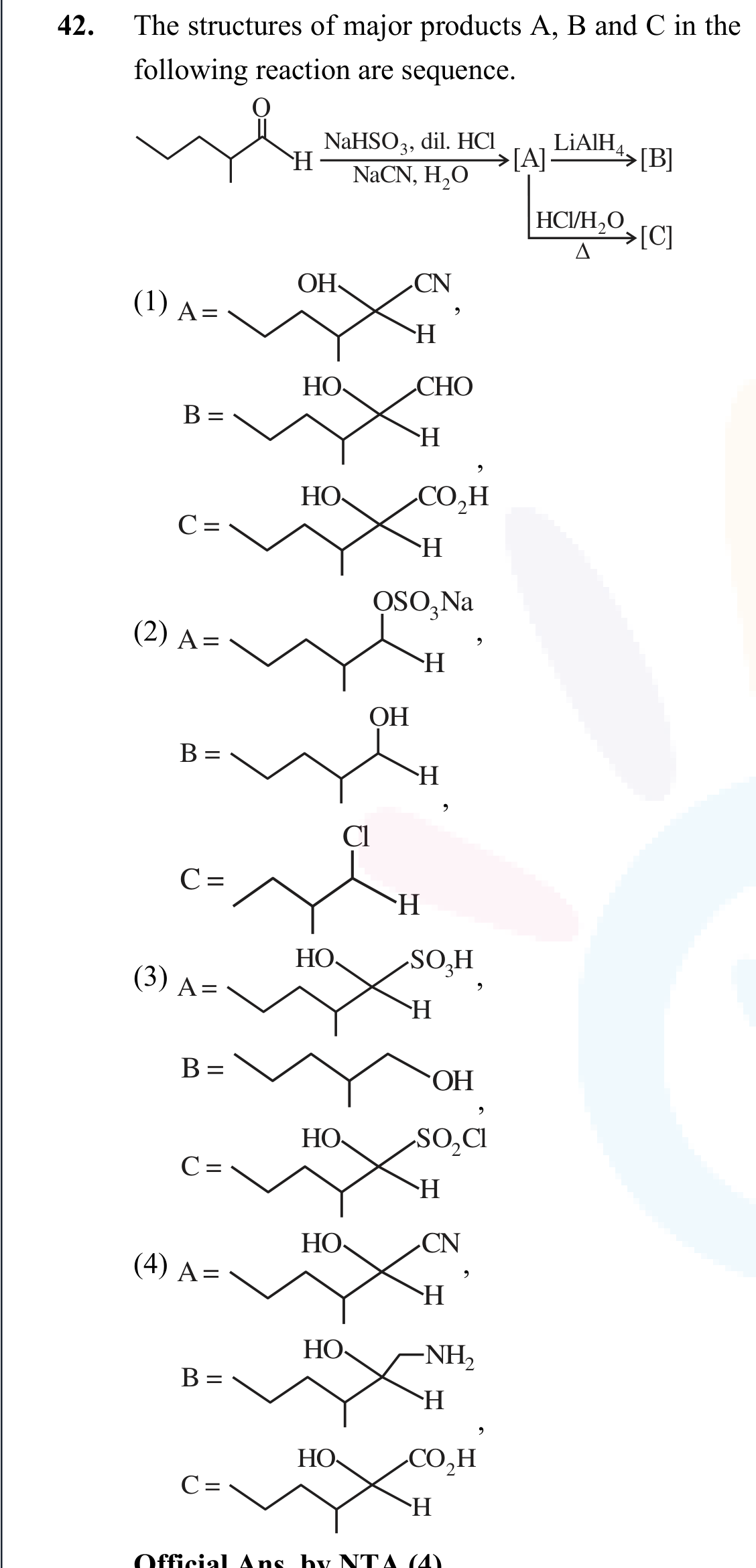
The structures of major products A, B and C in the following reaction are sequence.
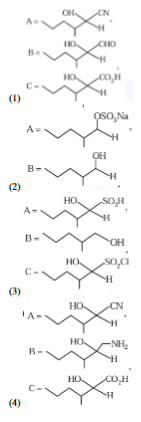
- A
(1)
- B
(2)
- C
(3)
- D
(4)
The structures of major products A, B and C in the following reaction are sequence.
(1)
(2)
(3)
(4)
Correct answer:C
Standard Method
Given: The starting compound undergoes successive reactions to form A, B and C.
Find: The correct sequence of structures for A, B and C.
Step 1: Reaction with / dilute and gives cyanohydrin formation. The ion attacks the carbonyl carbon and the oxygen is protonated. Therefore, A is the cyanohydrin product.
Step 2: Reduction with converts the nitrile group into a primary amine . Therefore, B is the corresponding amino alcohol.
Step 3: Hydrolysis with and heat converts the nitrile-derived functionality to a carboxylic acid. Therefore, C is the corresponding hydroxy carboxylic acid.
The solution states that A is 2-hydroxy-2-methylbutanenitrile, B is 1-amino-2-methylbutan-2-ol, and C is 2-hydroxy-2-methylbutanoic acid.
Hence, the structures match option (4). The correct option is C.
Reaction-wise Identification
Given: A multistep organic conversion with products A, B and C.
Find: Which option gives the correct structures.
Identify the transformations one by one:
So the required pattern is:
Among the given figures, this sequence appears in option (4), which corresponds to label C in the remapped options.
Assuming alone gives the final product is incorrect because the key carbon nucleophile comes from . The correct first transformation is cyanohydrin formation, not only bisulfite addition.
Reducing a nitrile to an aldehyde here is incorrect. With , the nitrile is reduced further to a primary amine. So B must contain , not .
Confusing acidic hydrolysis with simple substitution is incorrect. Under and heat, the nitrile-derived functionality ultimately gives a carboxylic acid, so C must contain .
Get unlimited AI-adaptive practice, mastery tracking, and an AI tutor that explains every step — free to start.