MCQMediumJEE 2023Alkenes (Electrophilic Addition, Polymerisation)

JEE Chemistry 2023 Question with Solution

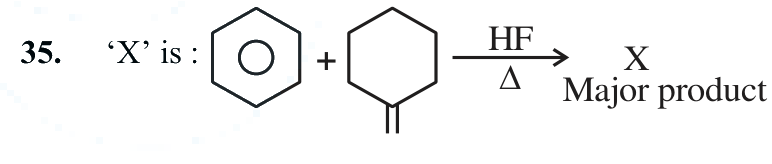
'X' is:

Reaction scheme showing benzene reacting with methylenecyclohexane in presence of HF and heat to form major product X.
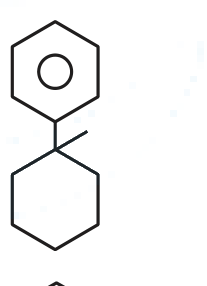
  • A
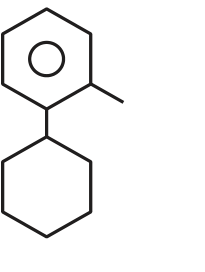
    Structure showing benzene ring attached through a tertiary carbon to a cyclohexane ring, with an additional methyl group on that junction carbon.
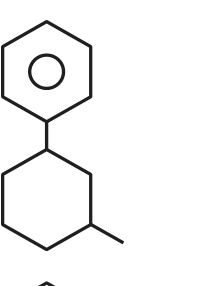
  • B
    Structure showing benzene ring connected to a cyclohexane ring through a single carbon linker, with a methyl substituent on the lower right carbon of cyclohexane.
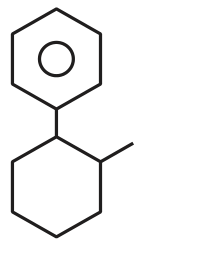
  • C
    Structure showing benzene ring connected to a cyclohexane ring through a single carbon linker, with a methyl substituent on the upper right carbon of cyclohexane.
  • D
    Structure showing benzene ring connected to a cyclohexane ring through a single carbon linker, with a methyl substituent on the benzene-adjacent upper right carbon.

Answer

Correct answer:A

Step-by-step solution

Standard Method

Given: The reactants are tetrahydrofuran (THF) and 2-methylpropene. The reaction is catalyzed by HF and takes place under heat.

Find: The major product X.

This reaction proceeds through electrophilic addition. HF protonates the alkene to form a carbocation. Then the oxygen of THF acts as a nucleophile and attacks that carbocation, followed by deprotonation.

The major product is determined by Markovnikov's rule. The proton adds to the carbon of the double bond having more hydrogens, so the carbocation forms on the more substituted carbon of 2-methylpropene.

Because the more stable carbocation intermediate is formed, the product corresponding to structure (1) is the major product.

Therefore, the correct option is A.

Common mistakes

  • Choosing the product by direct visual matching without identifying the carbocation intermediate is incorrect. The major product must be based on the most stable carbocation formed first. Determine the protonation step before selecting the structure.

  • Ignoring Markovnikov's rule leads to the wrong attachment pattern. In electrophilic addition, protonation occurs so that the more substituted carbocation is formed. Use carbocation stability, not random addition, to decide the product.

Practice more Alkenes (Electrophilic Addition, Polymerisation) questions

Get unlimited AI-adaptive practice, mastery tracking, and an AI tutor that explains every step — free to start.

Related questions