
Equivalent resistance between the adjacent corners of a regular -sided polygon of uniform wire of resistance would be:
- A
- B
- C
- D
Equivalent resistance between the adjacent corners of a regular -sided polygon of uniform wire of resistance would be:
Correct answer:D
Standard Method
Given: A regular -sided polygon is made of uniform wire of total resistance .
Find: The equivalent resistance between two adjacent corners.
Let the resistance of each side be
because the total wire is divided equally among sides.
Between adjacent corners and , there are two parallel paths:
So, the equivalent resistance is
Therefore,
Now substitute
Hence,
Therefore, the equivalent resistance is . The extracted solution working gives this value, although the solution incorrectly labels it as Option 4 / D. With the given options, this value corresponds to Option A.
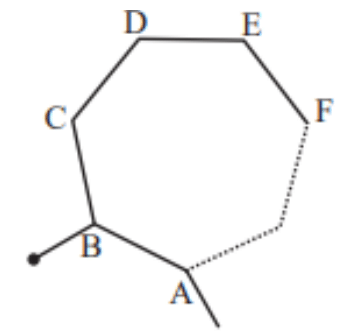
Parallel Path Interpretation
Given: Total resistance of the polygonal wire is and all sides are equal.
Find: Equivalent resistance across two adjacent vertices.
Because the wire is uniform, each side has the same resistance:
If the terminals are connected across adjacent corners, current can go from one corner to the other in two ways:
These two paths join the same pair of nodes, so they are in parallel. Using the parallel combination formula,
The denominator becomes
So,
Substituting ,
Therefore, the correct option by value is A.
Treating the whole polygon as a series network is wrong because between adjacent corners there are two distinct paths for current. Recognize that the direct side and the remaining path are in parallel.
Using as the resistance of each side is incorrect. is the total resistance of the entire polygon, so each side has resistance .
Adding and directly to get the equivalent resistance is incorrect because those resistances are not in series between the same two terminals. Use the parallel formula instead.
Get unlimited AI-adaptive practice, mastery tracking, and an AI tutor that explains every step — free to start.