
The total number of chiral compound/s from the following is _____ .
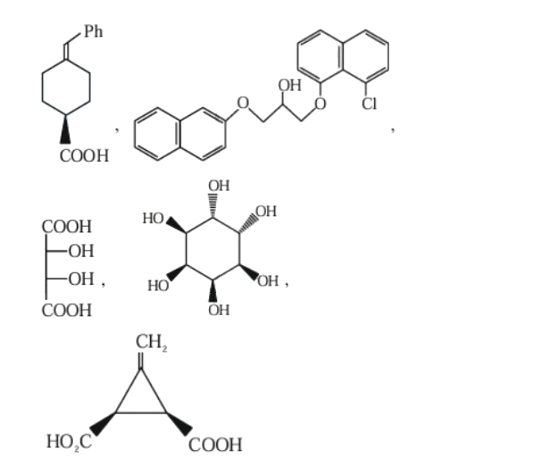

The total number of chiral compound/s from the following is _____ .
Correct answer:2
Standard Method
Given: Four compounds are shown, and we need to count how many are chiral.
Find: The total number of chiral compounds.
A molecule is chiral if it has at least one chiral carbon attached to four different groups, and the molecule does not have internal symmetry that removes chirality.
Analyze each compound:
Therefore, the total number of chiral compounds is .
Counting every carbon bearing a substituent as a chiral center. A carbon is chiral only if it is attached to four different groups. Always check all four attachments before declaring chirality.
Ignoring symmetry in the molecule. Even if substituted carbons are present, internal symmetry can make the compound achiral. Check for planes or centers of symmetry before counting it as chiral.
Assuming that a molecule with multiple OH groups must be achiral or always chiral. The correct approach is to examine each stereogenic center and the overall molecular symmetry together.
Get unlimited AI-adaptive practice, mastery tracking, and an AI tutor that explains every step — free to start.