
Cyclohexylamine when treated with nitrous acid yields (P). On treating (P) with PCC results in (Q). When (Q) is heated with dilute NaOH, we get (R). The final product (R) is:
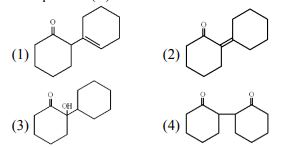
- A
Option (1)
- B
Option (2)
- C
Option (3)
- D
Option (4)
Cyclohexylamine when treated with nitrous acid yields (P). On treating (P) with PCC results in (Q). When (Q) is heated with dilute NaOH, we get (R). The final product (R) is:
Option (1)
Option (2)
Option (3)
Option (4)
Correct answer:B
Standard Method
Given: Cyclohexylamine is treated successively with nitrous acid, PCC, and dilute NaOH on heating.
Find: The final product (R).
Cyclohexylamine reacts with nitrous acid to give the corresponding alcohol (P). Oxidation of this alcohol with PCC gives the ketone (Q).
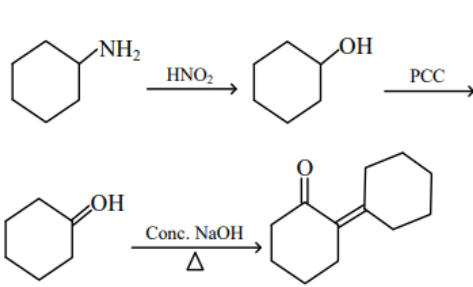
On heating (Q) with dilute NaOH, condensation occurs to form the cyclohexene derivative shown in option (2).
Therefore, the correct option is B.
Extracted Explanation
Given: Cyclohexylamine reacts with nitrous acid.
Find: Which structure corresponds to the final product (R).
Cyclohexylamine reacts with nitrous acid to form (P). On treating this with PCC (Pyridinium chlorochromate), oxidation occurs to form a ketone (Q). When (Q) is heated with dilute NaOH, it undergoes a condensation reaction forming a cyclohexene derivative (R). Thus, the final product (R) is the structure shown in option (2).
Therefore, the correct option is B.
Assuming nitrous acid forms a stable diazonium salt here is incorrect because a primary aliphatic amine typically gives the corresponding alcohol. Convert cyclohexylamine first to cyclohexanol, not to an isolable diazonium product.
Treating PCC as if it gives an alkene directly is wrong. PCC oxidizes the alcohol intermediate to the ketone (Q), which then undergoes base-induced condensation on heating.
Choosing a saturated ketone product misses the effect of heating with NaOH. Under these conditions, condensation gives a more conjugated unsaturated product, so look for the alkene-containing structure.
Get unlimited AI-adaptive practice, mastery tracking, and an AI tutor that explains every step — free to start.