MCQMediumJEE 2023Alkenes (Electrophilic Addition, Polymerisation)

JEE Chemistry 2023 Question with Solution

A hydrocarbon ‘X’ with formula C6H8C_6H_8 uses two moles of H2H_2 on catalytic hydrogenation of its one mole. On ozonolysis, ‘X’ yields two moles of methane dicarbaldehyde. The hydrocarbon ‘X’ is:

  • A

    hexa-1,3,51, 3, 5-triene

  • B

    11-methylcyclopenta-1,41, 4-diene

  • C

    cyclohexa-1,31, 3-diene

  • D

    cyclohexa-1,41, 4-diene

Answer

Correct answer:D

Step-by-step solution

Standard Method

Given: Hydrocarbon XX has molecular formula C6H8C_6H_8 and consumes two moles of H2H_2 on catalytic hydrogenation of one mole of XX.

Find: The structure of hydrocarbon XX.

Catalytic hydrogenation using 22 moles of H2H_2 shows that XX contains two double bonds.

On ozonolysis, XX gives two moles of methane dicarbaldehyde. This cleavage pattern matches a six-membered ring having double bonds at the 1,41,4-positions, because each double bond cleavage produces aldehyde ends and the ring splits into two identical molecules of methane dicarbaldehyde.
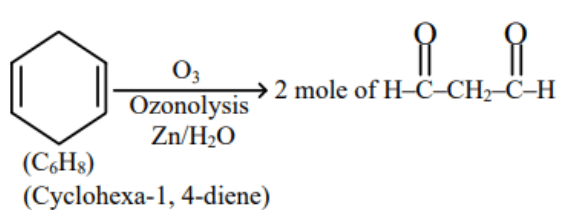
Cyclohexa-1,4-diene ring undergoing ozonolysis with ozone and zinc-water to give two molecules of methane dicarbaldehyde, with carbonyl groups shown explicitly.

Therefore, the hydrocarbon is cyclohexa-1,41, 4-diene. The correct option is D.

Using hydrogenation and ozonolysis clues

Given: C6H8C_6H_8 hydrocarbon, hydrogenation consumes 22 moles of H2H_2, and ozonolysis gives 22 moles of methane dicarbaldehyde.

Find: Which option matches the structure.

From hydrogenation, the compound must have two C=CC=C bonds.

The ozonolysis product is specifically methane dicarbaldehyde, so the parent diene must cleave in such a way that the ring opens into two identical three-carbon dialdehyde fragments.

This requirement is satisfied by cyclohexa-1,41, 4-diene. Hence the correct option is D.

Common mistakes

  • Assuming that consuming 22 moles of H2H_2 always means an open-chain diene is wrong, because cyclic dienes also hydrogenate similarly. Use ozonolysis data together with hydrogenation data.

  • Choosing cyclohexa-1,31, 3-diene by focusing only on the presence of two double bonds is incorrect. The position of the double bonds determines the ozonolysis fragments, so the product pattern must be checked.

  • Ignoring the phrase two moles of methane dicarbaldehyde is a conceptual mistake. The number and identity of ozonolysis products are the key structural clue; they indicate formation of two identical fragments.

Practice more Alkenes (Electrophilic Addition, Polymerisation) questions

Get unlimited AI-adaptive practice, mastery tracking, and an AI tutor that explains every step — free to start.

Related questions
