
Choose the correct set of reagents for the following conversion
- A
- B
- C
- D
Choose the correct set of reagents for the following conversion
Correct answer:B
Standard Method
Given: has to be converted into .
Find: The correct sequence of reagents.
The solution states that the conversion proceeds through formation of a vicinal dibromide, then elimination to an alkyne, and finally selective hydrogenation to the cis-alkene.
Using the extracted explanation:
Lindlar catalyst selectively hydrogenates an alkyne to a cis-alkene.
Therefore, the correct option is B.
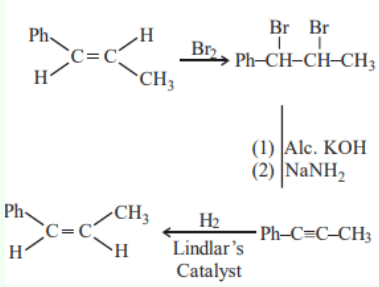
Reaction Sequence Explained
Given: The reagents must convert a trans-alkene into the corresponding cis-alkene.
Find: Which reagent set achieves this stereochemical change.
The extracted solution explains the steps as follows:
The reagent set written in the solution is
Hence the correct option is B.
The first solution image text mentions alc. KOH, but the detailed written solution and the declared correct option both identify B, so the answer follows the solution authority and option B.
Choosing at the last step is incorrect because dissolving metal reduction of an alkyne gives a trans-alkene, not a cis-alkene. Use with Lindlar catalyst to obtain the cis product.
Assuming bromination alone changes trans to cis is wrong. Bromination only creates a dibromide intermediate; the stereochemical inversion is achieved only after alkyne formation followed by partial hydrogenation.
Ignoring the role of is a conceptual error. It is needed for double dehydrohalogenation to convert the dibromide into an alkyne, which is the key intermediate before selective reduction.
Get unlimited AI-adaptive practice, mastery tracking, and an AI tutor that explains every step — free to start.