MCQEasyJEE 2023Electric Potential & Potential Energy

JEE Physics 2023 Question with Solution

Which of the following correctly represents the variation of electric potential (VV) of a charged spherical conductor of radius (RR) with radial distance (rr) from the centre?

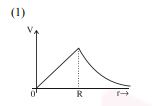
  • A
    Graph of electric potential V versus radial distance r showing potential rising linearly from zero at centre to a maximum at r equals R, then decreasing outside.
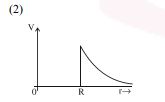
  • B
    Graph of electric potential V versus radial distance r showing zero potential inside until r equals R, then a sudden jump to high value followed by decrease outside.
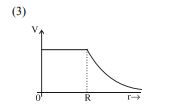
  • C
    Graph of electric potential V versus radial distance r showing constant potential from centre to r equals R, then decreasing smoothly with increasing r outside the conductor.
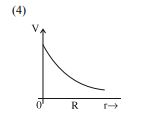
  • D
    Graph of electric potential V versus radial distance r showing continuously decreasing potential from centre onward, including inside and outside, without a flat region inside.

Answer

Correct answer:D

Step-by-step solution

Standard Method

Given: A charged spherical conductor of radius RR. We need the graph of electric potential VV as a function of radial distance rr from the centre.

Find: Which option correctly represents the variation of VV with rr.

For a charged spherical conductor, the electric potential is constant inside the conductor and equal to the potential at the surface. For points outside the conductor, the potential behaves as

V=kQrV = \frac{kQ}{r}

Therefore,

V=kQRforrRV = \frac{kQ}{R} \quad \text{for} \quad r \le R

and

V=kQrforr>RV = \frac{kQ}{r} \quad \text{for} \quad r > R

So the graph must be a horizontal line from r=0r = 0 to r=Rr = R, and then it must decrease as 1r\frac{1}{r} for r>Rr > R.

This matches option D in the solution's labeling, which corresponds to the 4th option in the given list.

Therefore, the correct option is D.

Why the inside region is flat

Given: The object is a spherical conductor, not an insulator.

Find: The shape of the VV versus rr graph.

Inside a conductor in electrostatic equilibrium, the electric field is zero. Since electric potential does not change where electric field is zero, the potential remains the same throughout the interior.

Hence, from the centre up to the surface at r=Rr = R, the potential is constant. After the surface, the conductor behaves like a point charge for potential, so

V1rV \propto \frac{1}{r}

for the outside region.

Thus the required graph is flat for rRr \le R and then falls for r>Rr > R. Therefore, the correct option is D.

Common mistakes

  • Assuming the potential inside the conductor is zero. That is wrong because electric field is zero inside a conductor, not necessarily the potential. The potential inside is constant and equal to the surface potential.

  • Using V1rV \propto \frac{1}{r} for the entire region from r=0r = 0 onward. That is incorrect because this expression is valid only for the region outside the spherical conductor. Inside, the graph must be flat.

  • Confusing a conducting sphere with a uniformly charged non-conducting sphere. For a non-conducting sphere, the inside variation is different. Here the conductor makes the interior potential constant.

Practice more Electric Potential & Potential Energy questions

Get unlimited AI-adaptive practice, mastery tracking, and an AI tutor that explains every step — free to start.

Related questions