
Match List I with List II:
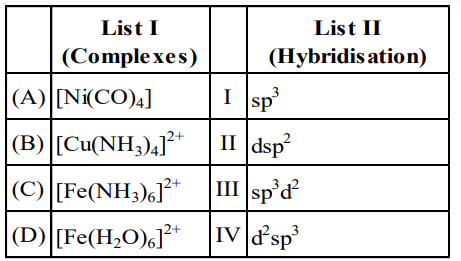
- A
A - II, B - I, C - III, D - IV
- B
A - I, B - II, C - III, D - IV
- C
A - II, B - I, C - IV, D - III
- D
A - I, B - II, C - IV, D - III
Match List I with List II:
A - II, B - I, C - III, D - IV
A - I, B - II, C - III, D - IV
A - II, B - I, C - IV, D - III
A - I, B - II, C - IV, D - III
Correct answer:C
Standard Method
Given: Match the coordination complexes with their hybridisations.
Find: The correct correspondence between List I and List II.
For , , hence the pairing of electrons does not occur in . Therefore, the complex is outer orbital and its hybridisation is .
Thus, the correct match is:
Therefore, the correct option is C.
Confusing inner-orbital and outer-orbital octahedral complexes. This is wrong because the ligand strength determines whether pairing occurs before hybridisation. Check whether is greater or smaller than pairing energy first.
Assuming all octahedral complexes use hybridisation. This is wrong because weak-field ligands can give outer-orbital complexes with hybridisation. Determine the field strength of the ligand before assigning hybridisation.
Treating as a square planar complex. This is wrong because is tetrahedral and corresponds to hybridisation. Use coordination number and ligand nature together.
Get unlimited AI-adaptive practice, mastery tracking, and an AI tutor that explains every step — free to start.