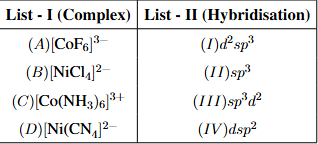
Given: The complexes are [CoF₆]³⁻, [NiCl₄]²⁻, [Co(NH₃)₆]³⁺, and [Ni(CN)₄]²⁻.
Find: Match each complex with the correct hybridisation by examining ligand strength, electron pairing, and geometry.
Weak field ligands such as F⁻ and Cl⁻ generally do not cause pairing in the d orbitals, so outer orbital complexes or tetrahedral arrangements are preferred. Strong field ligands such as NH₃ and CN⁻ can cause pairing, allowing inner orbital hybridisation.
Applying this:
- [CoF₆]³⁻ is octahedral with weak ligand F⁻, so it is outer orbital: sp3d2.
- [NiCl₄]²⁻ with weak ligand Cl⁻ is tetrahedral: sp3.
- [Co(NH₃)₆]³⁺ undergoes pairing and forms an inner orbital octahedral complex: d2sp3.
- [Ni(CN)₄]²⁻ with strong ligand CN⁻ forms a square planar complex: dsp2.
Hence the required match is (A)-(III), (B)-(II), (C)-(I), (D)-(IV), so the correct option is C.