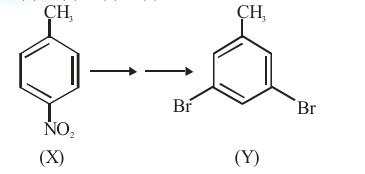
In the above conversion of compound (X) to product (Y), the sequence of reagents to be used will be:
- A
(i) , Fe (ii) (iii)
- B
(i) , Fe (ii) (iii)
- C
(i) Fe, (ii) (iii) ,
- D
(i) Fe, (ii) (iii) ,
In the above conversion of compound (X) to product (Y), the sequence of reagents to be used will be:

(i) , Fe (ii) (iii)
(i) , Fe (ii) (iii)
(i) Fe, (ii) (iii) ,
Correct answer:B
Standard Method
Given: Compound (X) is p-nitrotoluene and product (Y) is dibromotoluene. Find: The correct sequence of reagents for this conversion.

From the extracted solution, the sequence shown is:
First, the nitro group is reduced to an amino group using Fe, . Then bromination occurs on the activated aromatic ring with . Finally, the amino group is removed through diazotization with followed by reduction with to give the dibromo product.
Therefore, the correct option is B.
Note: The worked sequence in the solution image matches source option (4), but the solution explicitly states The Correct Option is B and also says Correct answer is (b). Hence the answer is taken as B by the page's stated conclusion, even though the reagent text corresponds to option D.
Reducing the nitro group after bromination is incorrect because the group is deactivating and meta-directing. The ring must first be converted to the more activating group to allow the required bromination pattern.
Using after diazotization would replace the diazonium group by Br, which adds another bromine instead of removing the amino-derived substituent. Here is needed for deamination.
Ignoring the discrepancy between listed option text and solution conclusion can lead to marking the wrong option. Always compare the final stated answer with the worked reagent sequence and note any mismatch explicitly.
Get unlimited AI-adaptive practice, mastery tracking, and an AI tutor that explains every step — free to start.