
Two long parallel wires carrying currents and in opposite directions are placed at a distance of from each other. A point P is at equidistant from both the wires such that the lines joining the point P to the wires are perpendicular to each other. The magnitude of magnetic field at P is _____ x .
NVAMediumJEE 2023Biot–Savart Law
JEE Physics 2023 Question with Solution
Answer
Correct answer:68
Step-by-step solution
Standard Method
Given: Two long parallel wires carry currents and in opposite directions. The separation between the wires is .
Find: The magnitude of magnetic field at point P in the form _____ x .
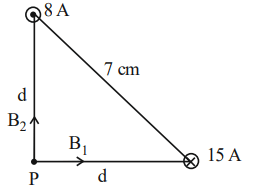
Magnetic fields due to both wires will be perpendicular to each other.
For each long straight wire,
Since the two magnetic fields are perpendicular,
Therefore,
From the geometry, the distances from P to both wires are equal and perpendicular, so
Now substitute:
Therefore, the required value is .
Geometry and vector addition
Given: Point P is equidistant from the two wires, and the lines joining P to the wires are perpendicular.
Find: Net magnetic field magnitude at P.
The figure forms a right triangle with equal legs and hypotenuse . Hence,
Now, magnetic field due to a long straight wire is
So,
Because the directions of these two fields at P are perpendicular, use Pythagoras for vector addition:
Using
and
we get the final magnetic field as
Therefore, the required numerical answer is .
Common mistakes
Using directly as the distance from P to each wire is incorrect because is the separation between the wires, not the perpendicular distance . First use the right-triangle geometry to find .
Adding the magnetic fields as is wrong because the two field vectors at P are perpendicular, not collinear. The correct relation is .
Forgetting to convert cm to m gives an answer off by a factor of . Always substitute distance in SI units in .
Practice more Biot–Savart Law questions
Get unlimited AI-adaptive practice, mastery tracking, and an AI tutor that explains every step — free to start.
Related questions
- An infinitely long straight wire carrying current I is bent in a planar shape as shown in the diagram. The…Medium · JEE 2026
- The current passing through a conducting loop in the form of equilateral triangle of side 4 3 cm is 2 A. The…Medium · JEE 2026
- Two identical circular loops P and Q each of radius r are lying in parallel planes such that they have common…Medium · JEE 2026
- The magnetic field at the centre of a current carrying circular loop of radius R is 16 T. The magnetic field…Easy · JEE 2026
- Let B1 be the magnitude of magnetic field at the center of a circular coil of radius R carrying current I.…Easy · JEE 2025
- A loop ABCD, carrying current I = 12 A, is placed in a plane, consists of two semi-circular segments of…Easy · JEE 2025