MCQMediumJEE 2023Phenols

JEE Chemistry 2023 Question with Solution

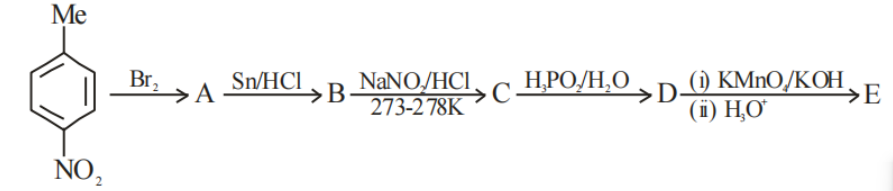
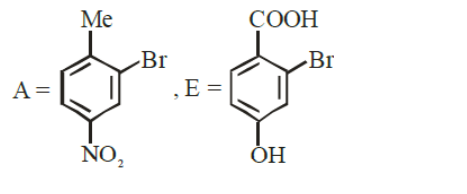
Identify the product formed (AA and EE) in the following reaction sequence:

Reaction sequence starting from p-nitrotoluene treated with bromine, then Sn/HCl, then NaNO2/HCl at 273 to 278 K, then H3PO2/H2O, and finally KMnO4/KOH followed by H3O+ to form product E.
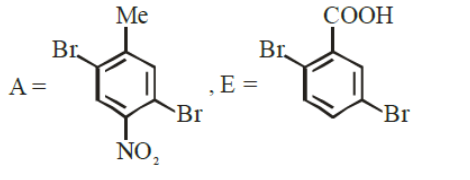
  • A
    Option A shows A as dibromo nitrotoluene with bromine substituents on both ortho positions relative to methyl, and E as dibromobenzoic acid retaining two bromine substituents.
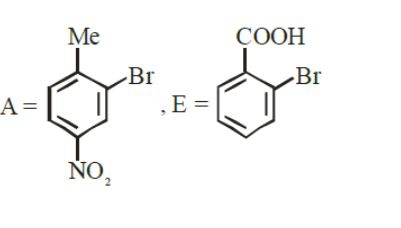
  • B
    Option B shows A as monobromo p-nitrotoluene and E as monobromobenzoic acid, both with bromine ortho to methyl and nitro converted to hydrogen in the final product.
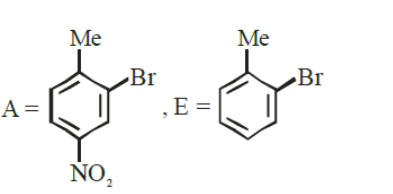
  • C
    Option C shows A as monobromo p-nitrotoluene with bromine ortho to methyl, and E as bromotoluene-like final structure lacking oxidation to carboxylic acid.
  • D
    Option D shows A as monobromo nitrotoluene and E as bromohydroxy benzoic acid containing both carboxylic acid and hydroxyl substituents.

Answer

Correct answer:C

Step-by-step solution

Standard Method

Given: The starting compound is pp-nitrotoluene and the sequence is bromination, reduction, diazotization, replacement of diazonium group, and side-chain oxidation.

Find: The correct pair of products AA and EE.

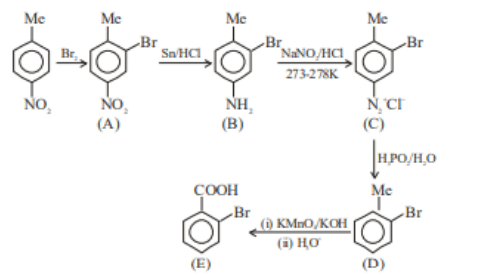
Worked reaction scheme showing p-nitrotoluene converted to brominated nitrotoluene A, then aniline derivative B, diazonium salt C, bromotoluene derivative D, and finally bromobenzoic acid E.

From the solution scheme:

  1. On treatment with Br2Br_2, bromination occurs to give product AA as monobromo nitrotoluene.
  2. Sn/HCl reduces the NO2NO_2 group to NH2NH_2 to form BB.
  3. NaNO2/HClNaNO_2/HCl at 273-278K273\text{-}278 \, \text{K} converts the amine into the diazonium salt CC.
  4. H3PO2/H2OH_3PO_2/H_2O replaces the diazonium group by hydrogen to give DD.
  5. Oxidation with KMnO4/KOHKMnO_4/KOH followed by H3O+H_3O^+ converts the methyl group into COOHCOOH, giving EE.

Therefore, the correct option is C.

Reaction Sequence Interpretation

Given: A multistep aromatic transformation is shown.

Find: Which option matches products AA and EE.

The solution explicitly states "The Correct Option is C" and the worked scheme confirms it.

The key transformations are:

  • Bromination introduces one BrBr substituent in the ring to form AA.
  • Reduction changes NO2NH2NO_2 \rightarrow NH_2.
  • Diazotization forms the diazonium salt.
  • H3PO2/H2OH_3PO_2/H_2O causes deamination, so the diazonium group is replaced by HH.
  • Side-chain oxidation converts MeCOOHMe \rightarrow COOH.

Hence the final pair is the one shown in option C according to the provided solution image and statement.

Common mistakes

  • Assuming that H3PO2/H2OH_3PO_2/H_2O gives phenol is incorrect. In this sequence it replaces the diazonium group by hydrogen, not OHOH. Track the specific reagent function before choosing the final ring substitution.

  • Ignoring the last oxidation step leads to choosing a structure that still contains MeMe. KMnO4/KOHKMnO_4/KOH followed by acid workup oxidizes the benzylic methyl group to COOHCOOH, so the final product EE must contain a carboxylic acid group.

  • Choosing a dibrominated product for AA is a common error. Only one bromination step is shown, so AA should be a monobromo derivative, not a dibromo compound.

Practice more Phenols questions

Get unlimited AI-adaptive practice, mastery tracking, and an AI tutor that explains every step — free to start.

Related questions