In the given circuit, the equivalent resistance between the terminal A and B is _____ .
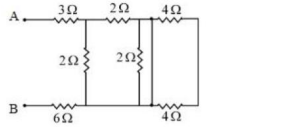
In the given circuit, the equivalent resistance between the terminal A and B is _____ .

Correct answer:10
Standard Method
Given: The circuit between terminals A and B.
Find: The equivalent resistance between A and B.

From the circuit reduction shown, both resistors are shorted, so they do not contribute to the equivalent resistance.
Now the remaining network gives
The parallel combination is
Substituting,
Therefore, the equivalent resistance between A and B is .
Using the observation about shorted resistors
Given: The circuit between terminals A and B.
Find: The equivalent resistance .
Observe the circuit carefully. The two resistors are connected across points that are already joined by an ideal wire path, so the potential difference across each of them is zero. Hence, no current flows through them and they can be removed.
After removing those resistors, the circuit reduces to a series combination of , the middle parallel part , and .
So,
with
Thus,
Therefore, the numerical value of the equivalent resistance is 10.
Treating the two resistors as active elements is incorrect because they are shorted by ideal wires and have zero potential difference across them. First identify branches with no current before combining resistors.
Adding the two resistors in series is wrong. They are connected between the same two nodes in the reduced circuit, so they are in parallel. Use , not .
Combining resistors before simplifying the short-circuited part can lead to an incorrect network. Redraw the circuit after removing branches with zero current, then apply series-parallel reduction step by step.
Get unlimited AI-adaptive practice, mastery tracking, and an AI tutor that explains every step — free to start.