
The urns , , and contain red, black; red, black, and red; black balls respectively. One of the urns is selected at random, and a ball is drawn. If the ball drawn is red and the probability that it is drawn from urn is , then the square of the length of the side of the largest equilateral triangle, inscribed in the parabola with one vertex at the vertex of the parabola, is:
NVAMediumJEE 2023Conditional Probability & Bayes Theorem
JEE Mathematics 2023 Question with Solution
Answer
Correct answer:432
Step-by-step solution
Standard Method
Given: The urns are chosen with equal probability. Urn has red and black balls, urn has red and black balls, and urn has red and black balls. Also, .
Find: The square of the side length of the largest equilateral triangle inscribed in with one vertex at the vertex of the parabola.
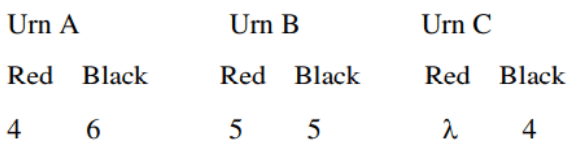
Using Bayes' theorem,
Since each urn is selected at random,
Also,
Therefore,
From the given working,
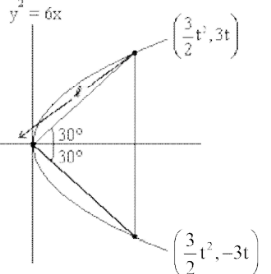
Now consider the parabola .
For the largest equilateral triangle, the upper vertex is taken as
Using the condition shown in the solution,
So,
which gives
Hence the point becomes
Therefore, the square of the side length is
Therefore, the required square of the side length is .
Solution Using Extracted Steps
Given: and the parabola is .
Find: for the largest inscribed equilateral triangle.
The extracted solution states the final answer as and shows the intermediate result
Then the parabola becomes
The triangle vertices used are the origin and the symmetric points
From the angle condition,
Thus,
Substituting,
Now the side squared is computed as
So the required answer is .
Note: Another textual approach in the solution mentions a different value of , but it conflicts with the extracted worked solution and the displayed final answer. As instructed, the solution's worked conclusion is treated as the authority.
Common mistakes
Using Bayes' theorem incorrectly by writing in place of or forgetting to divide by total probability of drawing a red ball. Always write the full conditional probability expression before substituting values.
Taking the parabola parameter point incorrectly. For , the standard parametric point is . Here gives , so the point becomes .
Computing the side length instead of its square. The question asks for , so after finding the coordinates, use the distance formula directly in squared form to avoid unnecessary square roots.
Practice more Conditional Probability & Bayes Theorem questions
Get unlimited AI-adaptive practice, mastery tracking, and an AI tutor that explains every step — free to start.
Related questions
- A bag contains 10 balls out of which k are red and (10-k) are black, where 0 k 10. If three balls are drawn…Medium · JEE 2026
- Given three identical bags each containing 10 balls, whose colours are as follows: Bag I 3 Red 2 Blue 5 Green…Medium · JEE 2025
- A card from a pack of 52 cards is lost. From the remaining 51 cards, n cards are drawn and are found to be…Medium · JEE 2025
- A bag contains 19 unbiased coins and one coin with heads on both sides. One coin is drawn at random and…Medium · JEE 2025
- If A and B are two events such that P(A) = 0.7, P(B) = 0.4 and P ( A B) = 0.5, where B denotes the complement…Medium · JEE 2025
- Two balls are selected at random one by one without replacement from a bag containing 4 white and 6 black…Medium · JEE 2025