
Structures of four disaccharides are given below. Among the given disaccharides, the non-reducing sugar is:
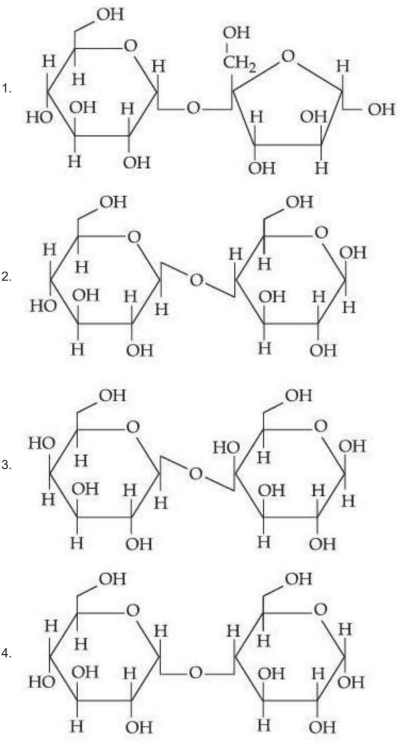
- A
Maltose
- B
Lactose
- C
Sucrose
- D
Cellobiose
Structures of four disaccharides are given below. Among the given disaccharides, the non-reducing sugar is:
Maltose
Lactose
Sucrose
Cellobiose
Correct answer:C
Standard Method
Given: Structures of four disaccharides are given and we have to identify the non-reducing sugar.
Find: Which among maltose, lactose, sucrose, and cellobiose is non-reducing.
Concept: Reducing sugars have a free anomeric carbon atom with a free group on the hemiacetal carbon, so they can open to form an aldehyde or ketone group. Non-reducing sugars do not have a free anomeric carbon because both anomeric carbons are involved in glycosidic linkage.
Step 1: Analyze each disaccharide.
Step 2: Conclusion. Sucrose is the only non-reducing sugar among the given disaccharides.
Therefore, the correct option is C.
Anomeric Carbon Check
Given: A set of disaccharides is provided.
Find: The non-reducing sugar.
A quick test is to check whether both anomeric carbons are tied up in the glycosidic bond. If both are involved, the sugar is non-reducing. If at least one anomeric carbon remains free, the sugar is reducing.
Among the listed sugars, only sucrose has both anomeric carbons involved in bond formation.
Therefore, the correct option is C.
Mistake: Treating every disaccharide as non-reducing. Why it is wrong: a disaccharide is non-reducing only when both anomeric carbons are involved in the glycosidic bond. What to do instead: check whether any anomeric carbon remains free.
Mistake: Looking only at the presence of a glycosidic linkage and ignoring which carbon atoms are connected. Why it is wrong: the reducing character depends specifically on the anomeric carbons, not merely on bond formation. What to do instead: identify the anomeric carbon in each monosaccharide unit first.
Mistake: Confusing or linkage with reducing or non-reducing nature. Why it is wrong: and describe stereochemistry, not whether a free anomeric carbon is present. What to do instead: determine reducing nature by checking for a free hemiacetal carbon.
Get unlimited AI-adaptive practice, mastery tracking, and an AI tutor that explains every step — free to start.