A thermodynamic system is taken through the cyclic process as shown in the diagram. The total work done by the system during the cycle is _____ J.
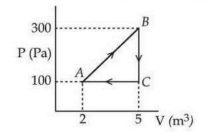
Given: The area enclosed by the cycle in the diagram represents the work done.
A thermodynamic system is taken through the cyclic process as shown in the diagram. The total work done by the system during the cycle is _____ J.

Given: The area enclosed by the cycle in the diagram represents the work done.
Correct answer:300
Standard Method
Given: The process is cyclic, and the work done in a cyclic process equals the area enclosed in the diagram.
Find: The total work done by the system during the cycle.
For a cyclic process:
From the diagram, the cycle forms a triangle.
Step 1: Identify base and height
Step 2: Calculate work done
Therefore, the total work done by the system during the cycle is .
Area of Triangle Interpretation
Given: The loop on the diagram encloses a triangular region.
Find: The numerical value of the work done in one complete cycle.
The net work done in any closed thermodynamic cycle is equal to the enclosed area on the graph.
Here the triangle has vertices corresponding to pressure values and , and volume values and .
So,
Now the enclosed area is
Since ,
Therefore, the required numerical answer is 300.
Using the full rectangle area instead of the triangular enclosed area is incorrect because the cycle encloses a triangle, not a rectangle. Use .
Taking the base or height directly as or is wrong because the dimensions of the enclosed figure are differences of coordinates. Use for volume change and for pressure change.
Forgetting that work in a cyclic process equals the area enclosed in the graph leads to an unnecessary process-by-process calculation. First identify the closed loop and then compute its enclosed area.
Get unlimited AI-adaptive practice, mastery tracking, and an AI tutor that explains every step — free to start.