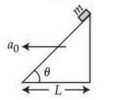
A small block of mass m slides down from the top of a frictionless inclined surface, while the inclined plane is moving towards left with constant acceleration a0. The angle between the inclined plane and ground is θ and its base length is L. Assuming that initially the small block is at the top of the inclined plane, the time it takes to reach the lowest point of the inclined plane is _.
A
gsin2θ−a0(1+cos2θ)4L
B
gsinθ−a0cosθ2L
C
gcos2θ−a0sinθcosθ4L
D
gsin2θ−a0(1+cos2θ)2L
Answer
Correct answer:B
Step-by-step solution
Standard Method
Given: A block of mass m slides on a frictionless incline. The inclined plane accelerates left with constant acceleration a0. The incline makes angle θ with the ground and has base length L.
Find: The time taken by the block to reach the lowest point of the incline.
Analyze the motion in the non-inertial frame of the inclined plane. In this frame, a pseudo force ma0 acts on the block opposite to the acceleration of the plane, that is, horizontally to the right.
Along the plane:
mgsinθ
acts downward along the incline, while
ma0cosθ
acts opposite to the downward motion.
Therefore, the effective acceleration along the incline is
aeff=gsinθ−a0cosθ
The length of the incline is
s=cosθL
Since the block starts from rest, use
s=21aefft2
So,
cosθL=21(gsinθ−a0cosθ)t2
Solving,
t2=cosθ(gsinθ−a0cosθ)2L
which simplifies to
t=gsinθ−a0cosθ2L
Therefore, the correct option is B.
Force Components Along the Incline
Given: The wedge accelerates left with acceleration a0, so in the wedge frame the block experiences a pseudo force to the right.
Find: Time of descent of the block.
The two relevant force components along the incline are:
Gravity component along incline: mgsinθ
Pseudo-force component along incline: ma0cosθ
Hence net force along the incline is
F∥=m(gsinθ−a0cosθ)
Thus,
a∥=gsinθ−a0cosθ
Now the geometry gives the incline length as
incline length=cosθL
Starting from rest,
cosθL=21(gsinθ−a0cosθ)t2
Rearranging gives the same result reported in the solution:
t=gsinθ−a0cosθ2L
Hence the answer is B.
Common mistakes
Using the ground frame directly without accounting for the accelerating incline is incorrect because the plane is a non-inertial frame for relative motion. Instead, switch to the frame of the incline and include the pseudo force ma0 opposite to the plane's acceleration.
Taking the pseudo-force component along the plane as ma0sinθ is wrong. Since the pseudo force is horizontal, its component along the incline is ma0cosθ.
Using the base length L as the distance travelled along the incline is incorrect because the block moves along the slanted surface. The correct distance is the incline length cosθL.
Practice more Newton's Second Law & Force questions
Get unlimited AI-adaptive practice, mastery tracking, and an AI tutor that explains every step — free to start.