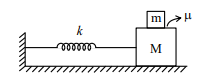
Two blocks of masses m and M, (M>m), are placed on a frictionless table as shown in figure. A massless spring with spring constant k is attached with the lower block. If the system is slightly displaced and released then (μ = coefficient of friction between the two blocks)
A
A, B, D Only
B
B, C, D Only
C
C, D, E Only
D
A, B, C Only
Answer
Correct answer:A
Step-by-step solution
Standard Method
Given: Two blocks of masses m and M move on a frictionless table, with the upper block in contact through static friction. The spring constant is k.
Find: Which statements among A, B, C, D, E are correct, and hence the correct option.
When the two blocks move together without slipping, they behave like a single body of mass M+m. The restoring force is provided by the spring.
Using Newton's second law for the combined system,
(M+m)a=−kx
So,
a=−M+mkx
This is the equation of SHM, hence
ω2=M+mk
Therefore,
T=2πkM+m
So statement A is correct.
From the same equation,
∣a∣=M+mkx
for displacement magnitude x from the mean position. So statement B is correct.
For the upper block, the only horizontal force is static friction. Therefore,
f=ma
Substituting the acceleration,
f=m(M+mk∣x∣)=M+mmk∣x∣
Hence the friction depends on k, not directly on μ. So statement C is incorrect.
For no slipping, the required friction must not exceed the maximum static friction.
frequired=mω2A
At the limiting condition,
mω2Amax=μmg
Thus,
Amax=ω2μg
Using
ω2=M+mk
we get
Amax=kμ(M+m)g
So statement D is correct.
The maximum friction between the two blocks is determined by the normal reaction between them, which is
N=mg
Therefore,
fmax=μmg
not μ(M+m)g. So statement E is incorrect.
Hence the correct statements are A, B, D only. Therefore, the correct option is A.
Statement-wise Check
Given: The lower block attached to the spring and the upper block move together unless slipping occurs.
Find: Evaluate each statement separately.
For the full system,
F=−kx
and total mass is M+m. Hence,
(M+m)a=−kx
which gives SHM with time period
T=2πkM+m
So A is true.
From the same result,
a=−M+mkx
Therefore the magnitude is
M+mkx
So B is true.
For the top block,
f=ma=m⋅M+mk∣x∣
Hence the expression in C is wrong because it contains μ instead of k. So C is false.
At extreme position, required friction is maximum:
f=mω2A
No slipping requires
mω2A≤μmg
At the limiting value,
Amax=kμ(M+m)g
So D is true.
Maximum static friction acts between the two blocks only, so
fmax=μN=μmg
Thus E is false.
Therefore the true statements are A, B, D, which matches option A. The solution also notes a discrepancy in labeling: the page's statement-combination option (1) corresponds to output label A here.
Common mistakes
Using only mass M in the time period formula is incorrect because both blocks move together when there is no slipping. Treat the oscillating mass as M+m.
Taking friction as μN at every instant is wrong. Static friction is self-adjusting and equals the force needed to accelerate the upper block, up to the maximum value μmg.
Using the normal force as (M+m)g for friction between the blocks is incorrect. The contact normal between the upper and lower blocks is only mg.
Practice more Newton's Second Law & Force questions
Get unlimited AI-adaptive practice, mastery tracking, and an AI tutor that explains every step — free to start.