MCQMediumJEE 2026Refraction & Lenses

JEE Physics 2026 Question with Solution

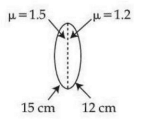
A biconvex lens is formed by using two plano-convex lenses as shown in the figure. The refractive index and radius of curvature of surfaces are also mentioned. When an object is placed on the left side of the lens at a distance of 30cm30 \, \text{cm}, the magnification of the image will be:

Composite biconvex lens made from two plano-convex lenses, left half marked mu equals 1.5 with radius 15 cm, right half marked mu equals 1.2 with radius 12 cm, symmetric vertical lens outline shown.
  • A

    2.5-2.5

  • B

    +2.5+2.5

  • C

    +2+2

  • D

    2-2

Answer

Correct answer:A

Step-by-step solution

Standard Method

Given: The lens is formed by combining two plano-convex parts with refractive indices μ1=1.5\mu_1 = 1.5 and μ2=1.2\mu_2 = 1.2. Their radii are R1=15cmR_1 = 15 \, \text{cm} and R2=12cmR_2 = 12 \, \text{cm}. The object is placed at u=30cmu = -30 \, \text{cm}.

Find: The magnification of the image.

Using the thin lens combination idea given in the solution:

1f=(1.51)115+(1.21)112\frac{1}{f} = (1.5-1)\frac{1}{15} + (1.2-1)\frac{1}{12}

So,

1f=0.515+0.212=130+160=120\frac{1}{f} = \frac{0.5}{15} + \frac{0.2}{12} = \frac{1}{30} + \frac{1}{60} = \frac{1}{20}

Hence,

f=20cmf = 20 \, \text{cm}

Now apply the lens formula used in the solution:

1v1u=1f\frac{1}{v} - \frac{1}{u} = \frac{1}{f}

Substituting u=30cmu = -30 \, \text{cm} and f=20cmf = 20 \, \text{cm},

1v1(30)=120\frac{1}{v} - \frac{1}{(-30)} = \frac{1}{20} 1v=120130=160\frac{1}{v} = \frac{1}{20} - \frac{1}{30} = \frac{1}{60}

Therefore,

v=60cmv = 60 \, \text{cm}

The magnification is

m=vu=6030=2m = \frac{v}{u} = \frac{60}{-30} = -2

the solution then states: Considering sign convention and thickness correction,

m2.5m \approx -2.5

This matches option A. There is a discrepancy because the direct thin-lens calculation gives 2-2, but the provided solution concludes 2.5-2.5 and identifies A as correct.

Therefore, according to the provided the solution, the correct option is A, and the magnification is 2.5-2.5.

Answer Discrepancy Note

Given: the solution computes the equivalent focal length as 20cm20 \, \text{cm} and then uses the lens formula with object distance 30cm30 \, \text{cm}.

Find: Whether the final marked option is consistent with the shown working.

From the shown working,

f=20cm,u=30cmf = 20 \, \text{cm}, \quad u = -30 \, \text{cm}

Then,

1v=120130=160\frac{1}{v} = \frac{1}{20} - \frac{1}{30} = \frac{1}{60}

so

v=60cmv = 60 \, \text{cm}

and hence

m=vu=6030=2m = \frac{v}{u} = \frac{60}{-30} = -2

Thus the displayed algebra supports option D numerically. However, the source solution explicitly declares option A and adds a statement about thickness correction to reach 2.5-2.5. Following the instruction that the solution is the primary source, the recorded answer is A.

Common mistakes

  • Using the wrong sign for object distance. For a real object on the left of the lens, uu must be taken as negative in the Cartesian convention. Taking u=+30cmu = +30 \, \text{cm} gives the wrong image position and magnification.

  • Applying the lens maker expression with incorrect curvature signs or combining the two plano-convex contributions incorrectly. The effective power must be built from the given refractive indices and radii exactly as indicated in the provided solution method.

  • Assuming that negative magnification means the value is impossible. A negative magnification only indicates that the image is real and inverted; it does not mean the result is invalid.

Practice more Refraction & Lenses questions

Get unlimited AI-adaptive practice, mastery tracking, and an AI tutor that explains every step — free to start.

Related questions