MCQEasyJEE 2026Nernst Equation

JEE Chemistry 2026 Question with Solution

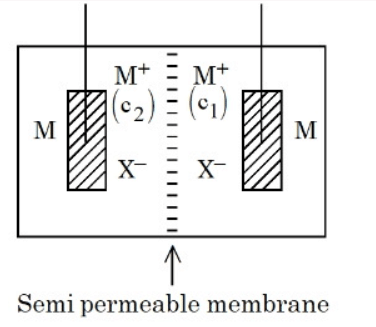
Electrochemical concentration cell with two metal electrodes M, separated by a semi permeable membrane, containing M+ ions at concentrations c2 on left and c1 on right, with X− counter ions in both compartments.

Consider the above electrochemical cell where a metal electrode (MM) is undergoing redox reaction by forming M+M^+ (MM++eM \to M^+ + e^-). The cation M+M^+ is present in two different concentrations c1c_1 and c2c_2 as shown above. Which of the following statement is correct for generating a positive cell potential?

  • A

    If c1c_1 is present at anode, then c1>c2c_1 > c_2.

  • B

    If c1c_1 is present at cathode, then c1>c2c_1 > c_2.

  • C

    If c1c_1 is present at anode, then c1=c2c_1 = c_2.

  • D

    If c1c_1 is present at cathode, then c1<c2c_1 < c_2.

Answer

Correct answer:D

Step-by-step solution

Standard Method

Given: The cell is a concentration cell of the form

MM+(c1)M+(c2)MM \,|\, M^+(c_1) \,||\, M^+(c_2) \,|\, M

Find: The correct condition for generating a positive cell potential.

For a concentration cell, the cell potential depends on the difference in ion concentrations. The solution states that for positive cell potential, the concentration at the cathode must be lower than the concentration at the anode.

The cell potential is given by

Ecell=RTFln([M+]anode[M+]cathode)E_{\text{cell}} = \frac{RT}{F} \ln \left( \frac{[M^+]_{\text{anode}}}{[M^+]_{\text{cathode}}} \right)

For positive potential,

Ecell>0E_{\text{cell}} > 0

so,

[M+]anode>[M+]cathode[M^+]_{\text{anode}} > [M^+]_{\text{cathode}}

If c1c_1 is present at the cathode, then it must be less than the concentration at the anode, that is,

c1<c2c_1 < c_2

Therefore, the correct option is D.

Using concentration-cell logic

Given: Both electrodes are the same metal and only the ion concentrations differ. Find: Which placement of c1c_1 and c2c_2 gives positive cell potential.

This is a concentration cell. Its driving force is the tendency to reduce the concentration difference between the two half-cells.

Oxidation occurs at the side where metal dissolves more readily, producing more M+M^+, so that side must already have the higher ion concentration according to the relation

Ecell=RTFln([M+]anode[M+]cathode)E_{\text{cell}} = \frac{RT}{F} \ln \left( \frac{[M^+]_{\text{anode}}}{[M^+]_{\text{cathode}}} \right)

Hence, for EcellE_{\text{cell}} to be positive,

[M+]anode>[M+]cathode[M^+]_{\text{anode}} > [M^+]_{\text{cathode}}

If c1c_1 is at the cathode, then the anode side must contain the larger concentration c2c_2. Therefore,

c1<c2c_1 < c_2

So the correct statement is If c1c_1 is present at cathode, then c1<c2c_1 < c_2, which is option D.

Common mistakes

  • Assuming the cathode must always have higher ion concentration. That is incorrect for this concentration cell as written in the provided solution expression. Use the given Nernst relation and check the sign condition for Ecell>0E_{\text{cell}} > 0.

  • Confusing the anode and cathode roles in a concentration cell. The electrode labels are decided by where oxidation and reduction occur, not by the left-right position in the diagram. Identify them from the condition for positive cell potential.

  • Choosing the option directly from intuition without comparing c1c_1 and c2c_2 mathematically. Substitute anode and cathode concentrations into the logarithmic expression before deciding the inequality.

Practice more Nernst Equation questions

Get unlimited AI-adaptive practice, mastery tracking, and an AI tutor that explains every step — free to start.

Related questions