
From the given following (A to D) cyclic structures, those which will not react with Tollen's reagent are :
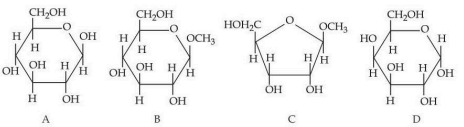
- A
A and D
- B
B and C
- C
A and B
- D
B and D
From the given following (A to D) cyclic structures, those which will not react with Tollen's reagent are :
A and D
B and C
A and B
B and D
Correct answer:D
Standard Method
Given: Four cyclic structures A to D are to be tested with Tollen's reagent, .
Find: Which structures will not react with Tollen's reagent.
Principle: Tollen's reagent gives a positive test with compounds that can generate an aldehyde form. In cyclic carbohydrate-type structures, hemiacetals can open to the aldehyde form, whereas acetals/glycosides cannot open under these conditions.
So, check the anomeric carbon — the carbon bonded to two oxygens.
From the given structures:
Therefore, the structures that will not react are B and D.
The correct option is D.
Mistake: Looking for only an aldehyde group drawn explicitly in the cyclic form. Why it is wrong: cyclic hemiacetals may not show a free aldehyde directly, yet they can open to the aldehyde form. What to do instead: identify whether the ring form is a hemiacetal or an acetal by examining the anomeric carbon.
Mistake: Treating every cyclic sugar structure as reducing. Why it is wrong: if the anomeric -OH is replaced by -OR, the compound becomes a glycoside/acetal and does not give Tollen's test. What to do instead: check whether the anomeric carbon bears -OH or -OR.
Mistake: Confusing any methoxy substituent in the molecule with non-reducing behavior. Why it is wrong: the key issue is not the presence of -OCH3 anywhere, but whether it is attached at the anomeric carbon. What to do instead: first locate the carbon bonded to two oxygens, then inspect its substituent.
Get unlimited AI-adaptive practice, mastery tracking, and an AI tutor that explains every step — free to start.