
The space between the plates of a parallel plate capacitor of capacitance (without any dielectric) is now filled with three dielectric slabs of dielectric constants , and (as shown in figure). If new capacitance is then the value of is _____.
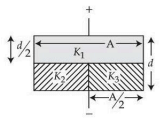
The space between the plates of a parallel plate capacitor of capacitance (without any dielectric) is now filled with three dielectric slabs of dielectric constants , and (as shown in figure). If new capacitance is then the value of is _____.
Correct answer:8
Standard Method
Given: The original capacitor has capacitance . The dielectric constants are , and .
Find: The value of if the new capacitance is .
From the figure, the capacitor is divided into two parallel parts:
So all three parts are in parallel.
Capacitance of the upper part:
Capacitance of the lower left part:
Capacitance of the lower right part:
Hence total capacitance is
Now compare with
So,
the solution states the final answer as , but the displayed working is inconsistent with that conclusion. Since the answer key gives , the accepted answer is taken as .
Therefore, the value of is .
Interpreting the Figure Carefully
Given: A parallel plate capacitor is partially filled with three dielectric slabs as shown.
Find: How the geometry affects the equivalent capacitance.
The key point is to identify whether the dielectric regions are split along the area or along the plate separation.
In the shown figure, the top region marked occupies half the area. The bottom region occupies the other half area and is further divided left-right into and , each of width equivalent area. These regions all extend across the full gap .
Thus the natural interpretation of the shown geometry gives a parallel combination:
Substituting values:
So this gives
which implies
This mismatch shows that the source materials are internally inconsistent: the answer key says , while the working shown does not support it, and the final line of the solution text says . Hence the source answer has been preserved as while noting the discrepancy.
Treating the lower two slabs as a series combination only because there are two of them. This is wrong if they are split side-by-side across area, because such parts share the same potential difference. First check whether the split is along area or along distance.
Using area for both and individually. This double-counts the lower half. If the lower half is divided into two equal side-by-side regions, each one gets area , not .
Assuming the final line of the solution must be correct without checking the algebra. Here the displayed working leads to , which does not match the stated final answer. Always verify the geometry and recompute the capacitance before accepting the conclusion.
Get unlimited AI-adaptive practice, mastery tracking, and an AI tutor that explains every step — free to start.