
Using a variable frequency ac voltage source the maximum current measured in the given LCR circuit is for The values of and are shown in the figure. The capacitance of the capacitor () used is _____ .
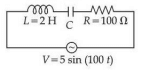
Using a variable frequency ac voltage source the maximum current measured in the given LCR circuit is for The values of and are shown in the figure. The capacitance of the capacitor () used is _____ .
Correct answer:50
Standard Method
Given: Maximum current is , source voltage is , so the peak voltage is and angular frequency is . From the figure, and .
Find: The capacitance .
The maximum current is
For a series LCR circuit,
So the impedance is
Since and , the impedance equals the resistance. Therefore the circuit is in resonance, so the reactances cancel:
That is,
Hence,
Substituting and ,
Therefore, the capacitance is .
Using Resonance Condition Explicitly
Given: At maximum current, the measured current is and the applied voltage is . The figure gives and .
Find: The value of .
First calculate the impedance from peak values:
Now compare with the resistance from the figure:
Thus,
In a series LCR circuit, this happens only at resonance, where
So,
Using
we get
Rearranging,
Now substitute the known values:
Convert to microfarads:
Therefore, the correct numerical answer is 50.
Using the given current as an rms current instead of the maximum current is incorrect because the question explicitly states maximum current. Use peak values consistently with and .
Ignoring the figure and assuming the wrong inductance is incorrect. The image shows , not . Using the wrong value changes the capacitance completely.
Not recognizing the resonance condition is a conceptual error. Since and this equals , the reactive part must be zero, so use .
Get unlimited AI-adaptive practice, mastery tracking, and an AI tutor that explains every step — free to start.