For the AC circuit shown in the figure, and , and the phase difference between and is . The input signal frequency is rad/sec, where is:
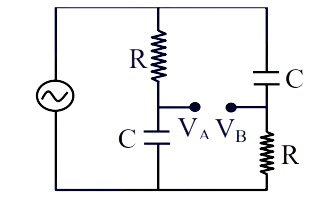
For the AC circuit shown in the figure, and , and the phase difference between and is . The input signal frequency is rad/sec, where is:

Correct answer:5
Standard Method
Given: , , and the phase difference between and is .
Find: The value of if the input angular frequency is written as rad/sec.
Using the phase condition stated in the solution for the RC circuit:
Now substitute the given values:
So,
Hence,
Therefore, in the form rad/sec, we get .
Using the phase relation between the two branches
Given: Two identical RC branches are connected as shown, with midpoint potentials and . Also, and .
Find: The exponent in the angular frequency rad/sec.
As stated in the extracted solution, the branch phase angles are equal in magnitude and opposite in direction. Therefore, if the phase difference between and is , each branch contributes .
For an RC branch at , the resistive and capacitive reactances are equal:
Using
we get
So,
Now substitute the values:
Thus,
Therefore, the required exponent is 5.
Time-constant shortcut
Given: and .
Find: in rad/sec.
When the phase condition leads to , the angular frequency is immediately:
Now,
Therefore,
So the frequency is of the form rad/sec with .
This shortcut works because the required phase condition fixes the circuit exactly at the point where the RC time constant satisfies with .
Using instead of angular frequency . The question already gives the input signal frequency in rad/sec, which corresponds to angular frequency. Do not divide by unless the question asks for frequency in Hz.
Multiplying and incorrectly. Here, and give , not . Keep powers of ten separate and combine them carefully.
Assuming the answer must come from directly. The extracted solution uses the circuit phase condition to reach . Follow the stated branch-phase relation rather than treating the series RC formula in isolation.
Get unlimited AI-adaptive practice, mastery tracking, and an AI tutor that explains every step - free to start.