
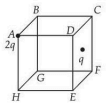
Two point charges and are placed at vertex A and centre of face CDEF of the cube as shown in figure. The electric flux passing through the cube is :
- A
- B
- C
- D
Two point charges and are placed at vertex A and centre of face CDEF of the cube as shown in figure. The electric flux passing through the cube is :
Correct answer:B
Standard Method
Given: Two point charges and are placed at a vertex and at the centre of a face of a cube.
Find: The total electric flux through the cube.
Using Gauss's law, the total electric flux through a closed surface is
When a charge lies on the boundary, only the symmetric fraction belonging to the cube is counted.
For the charge at vertex A, the charge is shared by identical cubes. Hence its contribution is
For the charge at the centre of face CDEF, the charge is shared by identical cubes. Hence its contribution is
Therefore, total flux through the cube is
Therefore, the electric flux passing through the cube is . The correct option is B.
Treating the charge at the vertex as fully enclosed is incorrect because a vertex is shared by identical cubes. Use only the fraction of that charge for one cube.
Treating the charge at the face centre as fully enclosed is incorrect because a face is shared by cubes. Use only the fraction of that charge for one cube.
Adding charge values first without applying the sharing fractions gives a wrong flux. First find the effective enclosed charge from symmetry, then apply Gauss's law.
Get unlimited AI-adaptive practice, mastery tracking, and an AI tutor that explains every step — free to start.