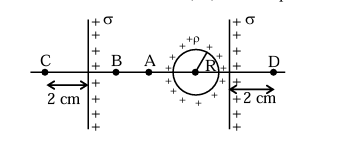
Two infinite identical charged sheets and a charged spherical body of charge density ' ' are arranged as shown in figure. Then the correct relation between the electrical fields at , , and points is:
- A
- B
- C
- D
Two infinite identical charged sheets and a charged spherical body of charge density ' ' are arranged as shown in figure. Then the correct relation between the electrical fields at , , and points is:

Correct answer:C
Standard Method
Given: Two infinite identical charged sheets and a uniformly charged spherical body of volume charge density are placed as shown. Find: the correct relation among the electric fields at .
For an infinite sheet of charge, the field magnitude is
on each side. For a uniformly charged non-conducting sphere, the field inside increases with distance from the center, while outside it behaves like the field of a point charge at the center.
Between the two identical sheets, the fields due to the sheets cancel each other, so at points and the net field is mainly due to the charged sphere. Since the electric field inside the sphere increases with radial distance from the center, and is farther from the center than , we get
At points and , which are outside the sheets, the field due to the sheets is the same in magnitude in the corresponding outer regions, but the contribution from the sphere is in opposite directions relative to the sheet field. Hence the resultant fields at and are not equal.
Therefore, the correct option is C.
Assuming the sheet field is different at and . This is wrong because the two identical infinite sheets produce equal and opposite fields in the region between them. First cancel the sheet contribution there, then compare the sphere's field.
Treating the sphere's field as constant inside the sphere. This is incorrect for a uniformly charged non-conducting sphere, where the field inside depends on distance from the center and increases with . So points at different distances from the center need not have equal fields.
Concluding only from symmetry of the sheets. This ignores the spherical body's contribution, which affects the two outer points differently in direction relative to the sheet field. Always superpose fields from all charge distributions.
Get unlimited AI-adaptive practice, mastery tracking, and an AI tutor that explains every step — free to start.