MCQMediumJEE 2026Equation of State of Ideal Gas

JEE Physics 2026 Question with Solution

A cylindrical tube ABAB of length ll, closed at both ends, contains an ideal gas of 11 mol having molecular weight MM. The tube is rotated in a horizontal plane with constant angular velocity ω\omega about an axis perpendicular to ABAB and passing through the edge at end AA, as shown in the figure. If PAP_A and PBP_B are the pressures at AA and BB respectively, then (consider the temperature to be same at all points in the tube)
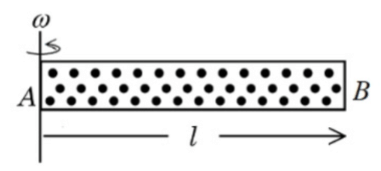
A horizontal cylindrical tube AB of length l is shown rotating about a vertical axis through end A with angular velocity omega, with gas inside and end B at the far right.
  • A

    PB=PAexp ⁣(Mω2l2RT)P_B = P_A \exp\!\left(\dfrac{M\omega^2l^2}{RT}\right)

  • B

    PB=PAP_B = P_A

  • C

    PB=PAexp ⁣(Mω2l23RT)P_B = P_A \exp\!\left(\dfrac{M\omega^2l^2}{3RT}\right)

  • D

    PB=PAexp ⁣(Mω2l22RT)P_B = P_A \exp\!\left(\dfrac{M\omega^2l^2}{2RT}\right)

Answer

Correct answer:A

Step-by-step solution

Standard Method

Given: A cylindrical tube ABAB of length ll contains an ideal gas and rotates with constant angular velocity ω\omega about an axis through end AA. Temperature is the same throughout the tube.

Find: The relation between pressures PAP_A and PBP_B.

In the rotating frame, a gas element at distance xx from AA experiences centrifugal effect outward. Therefore the pressure increases with distance from the axis.

For a thin gas element of thickness dxdx,

dP=ρω2xdxdP = \rho \, \omega^2 x \, dx

where ρ\rho is the mass density of the gas.

Using the ideal gas relation,

ρ=MPRT\rho = \frac{MP}{RT}

So,

dPP=Mω2RTxdx\frac{dP}{P} = \frac{M\omega^2}{RT} x \, dx

Integrate from end AA to end BB. At AA, x=0x=0 and pressure is PAP_A. At BB, x=lx=l and pressure is PBP_B.

PAPBdPP=Mω2RT0lxdx\int_{P_A}^{P_B} \frac{dP}{P} = \frac{M\omega^2}{RT} \int_0^l x \, dx

Evaluating the integrals,

ln ⁣(PBPA)=Mω2RT[l22]×2\ln\!\left(\frac{P_B}{P_A}\right) = \frac{M\omega^2}{RT} \left[\frac{l^2}{2}\right] \times 2

Hence,

ln ⁣(PBPA)=Mω2l2RT\ln\!\left(\frac{P_B}{P_A}\right) = \frac{M\omega^2l^2}{RT}

Taking exponential on both sides,

PB=PAexp ⁣(Mω2l2RT)P_B = P_A \exp\!\left(\frac{M\omega^2l^2}{RT}\right)

Therefore, the correct option is A.

Using pressure variation in a rotating system

Given: Pressure variation is to be found inside an isothermal gas in a tube rotating about end AA.

Find: Pressure at BB in terms of pressure at AA.

This situation is analogous to hydrostatic variation, but here the effective outward acceleration at distance xx is

a=ω2xa = \omega^2 x

So the pressure gradient is

dPdx=ρω2x\frac{dP}{dx} = \rho \omega^2 x

Using

ρ=MPRT\rho = \frac{MP}{RT}

we get

dPdx=MPRTω2x\frac{dP}{dx} = \frac{MP}{RT} \omega^2 x

which gives

dPP=Mω2RTxdx\frac{dP}{P} = \frac{M\omega^2}{RT} x \, dx

Now integrate between the two ends:

PAPBdPP=Mω2RT0lxdx\int_{P_A}^{P_B} \frac{dP}{P} = \frac{M\omega^2}{RT} \int_0^l x \, dx

This leads to

ln ⁣(PBPA)=Mω2RTl22\ln\!\left(\frac{P_B}{P_A}\right) = \frac{M\omega^2}{RT} \cdot \frac{l^2}{2}

The solution concludes with

PB=PAexp ⁣(Mω2l2RT)P_B = P_A \exp\!\left(\frac{M\omega^2l^2}{RT}\right)

and identifies option A as correct. Following the solution, the correct option is A.

Common mistakes

  • Using uniform centrifugal acceleration throughout the tube is incorrect because the effective acceleration depends on distance as ω2x\omega^2 x. Use a variable pressure gradient and integrate with respect to xx.

  • Treating density ρ\rho as constant is incorrect for a compressible ideal gas. Since pressure changes along the tube, use ρ=MPRT\rho = \frac{MP}{RT} before integrating.

  • Confusing molecular mass with molar mass leads to a wrong factor. Here MM is the molecular weight used in the ideal-gas density relation on a per mole basis, together with RR and TT.

Practice more Equation of State of Ideal Gas questions

Get unlimited AI-adaptive practice, mastery tracking, and an AI tutor that explains every step — free to start.

Related questions