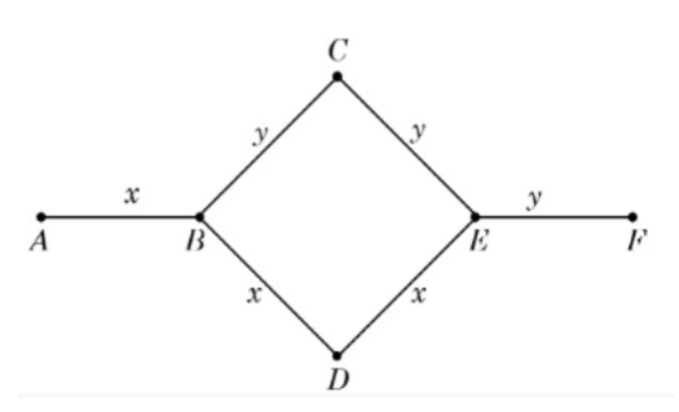
Given: Temperatures at the ends are 100∘C at A and 40∘C at F. All rods have equal length and area. Thermal conductivity kx=3ky.
Find: The temperatures at junctions B and E.
Use the thermal resistance relation
R=kAL
Since kx=3ky, we get
Rx=kxAL=31kyAL=31Ry
Between B and E, heat can flow through two parallel branches:
B→C→E
and
B→D→E
The upper branch has resistance 2Ry and the lower branch has resistance 2Rx. Therefore, the equivalent resistance between B and E is
RBE=(2Ry1+2Rx1)−1
Substituting Rx=31Ry,
RBE=(2Ry1+2Ry3)−1=(2Ry4)−1=2Ry
Now the full path from A to F is a series combination:
Rtotal=Rx+RBE+Ry
So,
Rtotal=3Ry+2Ry+Ry=611Ry
The total temperature difference is
ΔT=100−40=60∘C
The temperature drop across AB is proportional to Rx:
ΔTAB=60×RtotalRx=60×611Ry3Ry=60×112≈20∘C
Hence,
TB≈100−20=80∘C
The temperature drop across EF is proportional to Ry:
ΔTEF=60×RtotalRy=60×611RyRy=60×116≈30∘C
Therefore,
TE≈40+30=70∘C
So the temperatures are 80∘C and 70∘C respectively. The correct option is C.