NVAMediumJEE 2025Heat Transfer (Conduction, Convection, Radiation)

JEE Physics 2025 Question with Solution

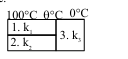
Three conductors of same length having thermal conductivity k1k_1, k2k_2, and k3k_3 are connected as shown in figure. Area of cross sections of 1st and 2nd conductor are same and for 3rd conductor it is double of the 1st conductor. The temperatures are given in the figure. In steady state condition, the value of θ\theta is _____ C^\circ\text{C}. (Given: k1k_1 = 60Js1m1K160 \, \text{Js}^{-1}\text{m}^{-1}\text{K}^{-1}, k2k_2 = 120Js1m1K1120 \, \text{Js}^{-1}\text{m}^{-1}\text{K}^{-1}, k3k_3 = 135Js1m1K1135 \, \text{Js}^{-1}\text{m}^{-1}\text{K}^{-1})

Three conductors arranged in a T-shaped network: conductors 1 and 2 on the left connected to conductor 3 on the right, with end temperatures 100 degree Celsius, 0 degree Celsius, and 0 degree Celsius marked.

Answer

Correct answer:40

Step-by-step solution

Standard Method

Given: The three conductors have the same length. Their thermal conductivities are k1=60Js1m1K1k_1 = 60 \, \text{Js}^{-1}\text{m}^{-1}\text{K}^{-1}, k2=120Js1m1K1k_2 = 120 \, \text{Js}^{-1}\text{m}^{-1}\text{K}^{-1}, and k3=135Js1m1K1k_3 = 135 \, \text{Js}^{-1}\text{m}^{-1}\text{K}^{-1}. Also, A1=A2=AA_1 = A_2 = A and A3=2AA_3 = 2A.

Find: The steady-state junction temperature θ\theta.

In steady state, the total heat current entering the junction equals the heat current leaving the junction.

For a conductor,

Q˙=kAΔTL\dot Q = \frac{kA\Delta T}{L}

So for the three branches,

Q˙1=k1A(100θ)L\dot Q_1 = \frac{k_1A(100-\theta)}{L} Q˙2=k2A(100θ)L\dot Q_2 = \frac{k_2A(100-\theta)}{L} Q˙3=k3(2A)(θ0)L\dot Q_3 = \frac{k_3(2A)(\theta-0)}{L}

Applying heat balance at the junction,

Q˙1+Q˙2=Q˙3\dot Q_1 + \dot Q_2 = \dot Q_3

Therefore,

k1A(100θ)L+k2A(100θ)L=2k3AθL\frac{k_1A(100-\theta)}{L} + \frac{k_2A(100-\theta)}{L} = \frac{2k_3A\theta}{L}

Cancelling the common factor AL\frac{A}{L},

(k1+k2)(100θ)=2k3θ(k_1+k_2)(100-\theta)=2k_3\theta

Substitute the given values:

(60+120)(100θ)=2×135θ(60+120)(100-\theta)=2\times 135\theta 180(100θ)=270θ180(100-\theta)=270\theta 18000180θ=270θ18000-180\theta=270\theta 18000=450θ18000=450\theta θ=40\theta=40

Therefore, the value of θ\theta is 40C40^\circ\text{C}.

Using Thermal Conductance

Given: Thermal conductance of a rod is G=kALG=\frac{kA}{L}. Here A1=A2=AA_1=A_2=A and A3=2AA_3=2A.

Find: The junction temperature θ\theta.

Write the conductances:

G1=k1AL,G2=k2AL,G3=2k3ALG_1=\frac{k_1A}{L}, \qquad G_2=\frac{k_2A}{L}, \qquad G_3=\frac{2k_3A}{L}

The two left rods are connected to 100C100^\circ\text{C} and the right rod is connected to 0C0^\circ\text{C}. Hence,

Q˙1=G1(100θ),Q˙2=G2(100θ),Q˙3=G3θ\dot Q_1=G_1(100-\theta), \qquad \dot Q_2=G_2(100-\theta), \qquad \dot Q_3=G_3\theta

At steady state,

Q˙1+Q˙2=Q˙3\dot Q_1+\dot Q_2=\dot Q_3

So,

k1AL(100θ)+k2AL(100θ)=2k3ALθ\frac{k_1A}{L}(100-\theta)+\frac{k_2A}{L}(100-\theta)=\frac{2k_3A}{L}\theta

After cancelling AL\frac{A}{L},

k1(100θ)+k2(100θ)=2k3θk_1(100-\theta)+k_2(100-\theta)=2k_3\theta

Substituting k1=60k_1=60, k2=120k_2=120, and k3=135k_3=135,

(60+120)(100θ)=270θ(60+120)(100-\theta)=270\theta 180(100θ)=270θ180(100-\theta)=270\theta 18000180θ=270θ18000-180\theta=270\theta θ=40\theta=40

Thus, the required temperature is 40C40^\circ\text{C}.

Common mistakes

  • Using Q˙1=Q˙2=Q˙3\dot Q_1=\dot Q_2=\dot Q_3 is incorrect here because two conductors bring heat into the junction while the third carries heat away. The correct steady-state condition is heat balance at the junction: Q˙1+Q˙2=Q˙3\dot Q_1+\dot Q_2=\dot Q_3.

  • Ignoring the doubled area of the third conductor gives the wrong conductance. Since A3=2AA_3=2A, its heat current must be written with 2A2A, so G3=2k3ALG_3=\frac{2k_3A}{L}.

  • Taking the temperature difference across conductor 3 as (0θ)(0-\theta) without handling the sign convention carefully can produce a negative heat current and wrong algebra. Choose one direction consistently and write the outgoing magnitude as Q˙3=2k3AθL\dot Q_3=\frac{2k_3A\theta}{L}.

Practice more Heat Transfer (Conduction, Convection, Radiation) questions

Get unlimited AI-adaptive practice, mastery tracking, and an AI tutor that explains every step — free to start.

Related questions