MCQMediumJEE 2026Newton's Law of Gravitation

JEE Physics 2026 Question with Solution

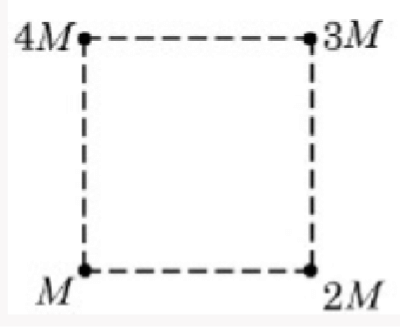
Net gravitational force at the center of a square is found to be F1F_1 when four particles having masses M,2M,3MM, 2M, 3M and 4M4M are placed at the four corners of the square as shown in figure, and it is F2F_2 when the positions of 3M3M and 4M4M are interchanged. The ratio F1F2=α5\dfrac{F_1}{F_2} = \dfrac{\alpha}{\sqrt{5}}. The value of α\alpha is

Square with four masses M, 2M, 3M and 4M placed at the four corners, asking net gravitational force at the center before and after interchanging 3M and 4M.
  • A

    11

  • B

    33

  • C

    252\sqrt{5}

  • D

    22

Answer

Correct answer:D

Step-by-step solution

Standard Method

Given: Four particles of masses M,2M,3MM, 2M, 3M and 4M4M are placed at the corners of a square. The net gravitational force at the center is F1F_1 in the first arrangement and F2F_2 after interchanging 3M3M and 4M4M.

Find: The value of α\alpha if

F1F2=α5\frac{F_1}{F_2} = \frac{\alpha}{\sqrt{5}}

Each corner of the square is at the same distance from the center, so the gravitational force due to each mass at the center is proportional to that mass.

Let the side of the square be aa. Distance from center to each corner is

r=a2r = \frac{a}{\sqrt{2}}

Resolve the forces along two perpendicular axes.

Case I — Original configuration:

Horizontal component is proportional to

(3MM)(3M - M)

Vertical component is proportional to

(4M2M)(4M - 2M)

Therefore,

F1(2M)2+(2M)2=2M2F_1 \propto \sqrt{(2M)^2 + (2M)^2} = 2M\sqrt{2}

Case II — After interchanging 3M3M and 4M4M:

Horizontal component is proportional to

(4MM)(4M - M)

Vertical component is proportional to

(3M2M)(3M - 2M)

Therefore,

F2(3M)2+(M)2=M10F_2 \propto \sqrt{(3M)^2 + (M)^2} = M\sqrt{10}

Now,

F1F2=2M2M10=25\frac{F_1}{F_2} = \frac{2M\sqrt{2}}{M\sqrt{10}} = \frac{2}{\sqrt{5}}

Comparing with

F1F2=α5\frac{F_1}{F_2} = \frac{\alpha}{\sqrt{5}}

we get

α=2\alpha = 2

Therefore, the correct option is D and the value of α\alpha is 22.

Vector Component View

Given: All four masses are at equal distance from the center of the square.

Find: Compare the magnitudes of the resultant gravitational forces in the two arrangements.

Because all corner distances from the center are equal, the common factor in gravitational force,

Gmr2\frac{Gm}{r^2}

is the same for every corner contribution. Hence only the mass values matter in forming the resultant.

For the first arrangement, the imbalance along one axis is 2M2M and along the perpendicular axis is also 2M2M. So the resultant is proportional to

(2M)2+(2M)2\sqrt{(2M)^2 + (2M)^2}

For the second arrangement, the imbalances become 3M3M and MM. So the resultant is proportional to

(3M)2+(M)2\sqrt{(3M)^2 + (M)^2}

Thus,

F1F2=8M210M2=810=45=25\frac{F_1}{F_2} = \frac{\sqrt{8M^2}}{\sqrt{10M^2}} = \sqrt{\frac{8}{10}} = \sqrt{\frac{4}{5}} = \frac{2}{\sqrt{5}}

Therefore,

α=2\alpha = 2

So the correct option is D.

Common mistakes

  • Taking the forces due to opposite corners as simple scalars instead of vectors is incorrect because gravitational forces at the center act along diagonals. Resolve into perpendicular components first, then use vector addition.

  • Assuming the force depends only on total mass is wrong because the arrangement of masses changes the component balance. Use the directional distribution of masses, not merely their sum.

  • Using unequal distances for different corner masses is incorrect because every corner of the square is equally distant from the center. Keep the common distance factor same for all four masses.

Practice more Newton's Law of Gravitation questions

Get unlimited AI-adaptive practice, mastery tracking, and an AI tutor that explains every step — free to start.

Related questions