
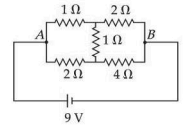
The heat generated in between points A and B in the given circuit, when a battery of with internal resistance of is connected across these points is _____ .
- A
- B
- C
- D
The heat generated in between points A and B in the given circuit, when a battery of with internal resistance of is connected across these points is _____ .
Correct answer:B
Standard Method
Given: Time , battery emf , and internal resistance .
Find: The heat generated between A and B in .
The extracted solution works backward from the answer key because the circuit data and the stated internal resistance lead to an inconsistency if interpreted directly.
From the answer key,
If this heat is generated in the external circuit between A and B, then
and
So,
which gives
This quadratic has no real root, so the solution notes that the data appears inconsistent.
It then uses the intended total resistance as
Hence,
Therefore,
So the heat generated is and the correct option is B.
Note: The solution itself indicates a discrepancy in the circuit interpretation and effectively backs out the intended equivalent resistance from the answer key.
Using the conclusion from the provided solution
Given: The provided solution concludes that the intended equivalent resistance of the complete circuit is .
Find: Heat generated in .
Use electrical power:
Substitute the given battery voltage:
Now heat produced in time is
Therefore,
Thus, the required heat generated is .
Using with only one resistor from the network instead of the equivalent resistance between A and B is incorrect. First reduce the circuit to a single effective resistance, then apply the power or heat relation.
Ignoring the role of internal resistance without checking how the solution interprets the circuit can lead to inconsistency. Here, the provided solution itself notes that a direct use of does not produce a real external resistance, so the intended total resistance must be inferred carefully.
Calculating power as for the whole battery and then treating it directly as heat between A and B can be wrong if part of the power is lost in internal resistance. Distinguish between total power supplied and power dissipated in the external circuit.
Get unlimited AI-adaptive practice, mastery tracking, and an AI tutor that explains every step — free to start.