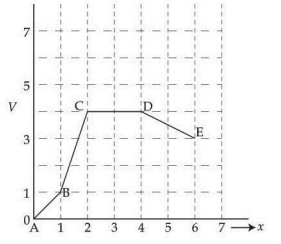
Potential energy () versus distance () is given by the graph. Rank various regions as per the magnitudes of the force () acting on a particle from high to low.
- A
- B
- C
- D
Potential energy () versus distance () is given by the graph. Rank various regions as per the magnitudes of the force () acting on a particle from high to low.

Correct answer:C
Standard Method
Given: A potential energy versus position graph with regions AB, BC, CD, DE.
Find: The ranking of the magnitudes of force in these regions.
The force is related to potential energy by
So, the magnitude of force is equal to the magnitude of the slope of the - graph:
From the graph, the approximate coordinates are:
Now calculate slopes in each region:
For AB,
Hence,
For BC,
Hence,
For CD,
Hence,
For DE,
Hence,
Therefore, the order from high to low is
So, the correct option is C.
Reading the Graph Carefully
Given: The force magnitude must be obtained from the slope of the potential energy graph, not from the height of the graph.
Find: Which region has the largest and smallest .
A steeper line means a larger magnitude of slope, and hence a larger magnitude of force. A horizontal segment means zero slope, so zero force magnitude.
Thus,
Therefore, the correct option is C.
The solution states point values that make AB and DE equal, but the graph and the listed options support the stricter ordering above. Hence the defensible answer is C.
Using the value of potential energy instead of the slope of the - graph. Force depends on , not on how high the graph is. Always compare the steepness of each segment.
Ignoring the magnitude and comparing signs of slopes. The question asks for magnitudes of force, so compare . A negative slope still gives a positive force magnitude.
Treating the horizontal region CD as having some force because the potential energy is nonzero there. A constant potential means zero slope, so the force is zero in that region.
Get unlimited AI-adaptive practice, mastery tracking, and an AI tutor that explains every step — free to start.